
 19 Oct 2026









- Whitefish: The total biomass in Lake Sevan increased more than tenfold over ten years, rising from several hundred tonnes in the mid-2010s to more than 4,500 tonnes as of July 2026.
- Sevan trout: Until 2025, stocks did not exceed 20 tonnes. They were estimated at approximately 138 tonnes in 2025 and 374 tonnes in July 2026.
- Caucasian leopard: Armenia estimates that six to seven individuals remain in the country. Two cubs were recorded in 2024.
- Caucasian red deer: Between 2022 and 2025, 22 individuals were released into the wild, and eight calves were born.
- Brown trout: Around 50,000 juveniles are scheduled to be released into mountain rivers this year.
Promises are There, but Progress is Too Slow: What Leaders Said at the Leaders for Nature Summit in Yerevan
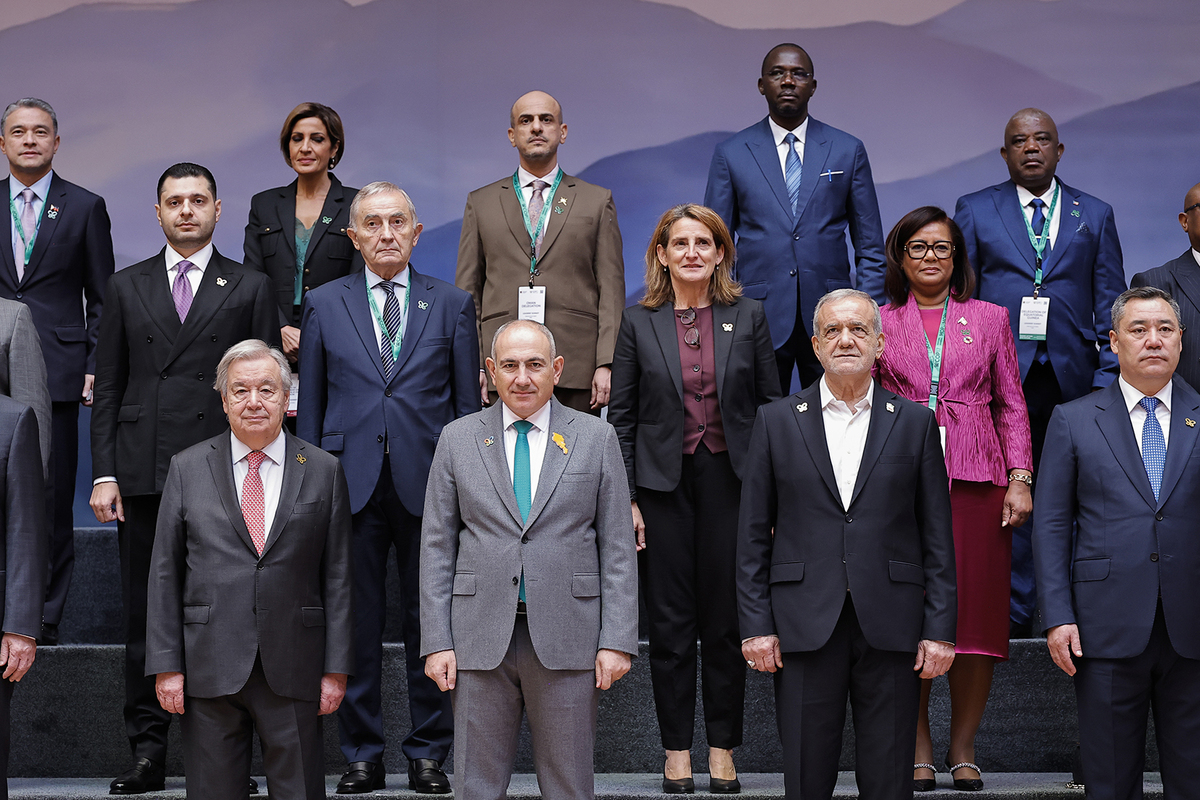
The Leaders for Nature Summit took place in Yerevan ahead of the 17th meeting of the Conference of the Parties to the Convention on Biological Diversity (COP17), which opens on 19 October. The conclusion repeated in different forms by leading participants remained unchanged: countries have made significant progress, but the world is not yet on track to meet its 2030 targets. Both the host country and the UN Secretary-General shared this assessment.
Scale and Format
The official opening ceremony was held the previous evening at the Karen Demirchyan Sports and Concert Complex. The main part of the summit is taking place at the Meridian Congress Centre, which houses the “Blue Zone”, the venue for official negotiations. The “Green Zone” remains at the Demirchyan Complex and will be open to the public from 19 to 30 October.
According to the organisers, delegations from 196 Parties to the Convention, including the European Union, and around 15,000 participants are expected at COP17. For Armenia, this is the largest international event in its history. Prime Minister Nikol Pashinyan made this point the previous day during a meeting with UN Secretary-General António Guterres. Following the conference, Armenia will assume the presidency of the process for two years. COP17 will also determine the host country for COP18, scheduled for 2028. Armenia has been a Party to the Convention since 29 December 1993.
The summit will conclude with the adoption of the Yerevan Declaration on Preserving Life on Earth. Its programme was divided into two stages. Following the welcoming ceremony and a group photograph of the leaders, a plenary session featuring their speeches took place. Round-table discussions were then scheduled on two themes: protecting nature for peace, security and sustainable development, and redirecting financial flows towards nature-positive development.
The participants represented a diverse range of countries and institutions. The leaders were welcomed by Pashinyan and President Vahagn Khachaturyan. Those attending included the presidents of Kazakhstan, Kassym-Jomart Tokayev; Tajikistan, Emomali Rahmon; Kyrgyzstan, Sadyr Japarov; and Turkmenistan, Serdar Berdimuhamedov. Georgian Prime Minister Irakli Kobakhidze, Iranian President Masoud Pezeshkian, Zanzibar President Hussein Ali Mwinyi and Algerian Council of the Nation Speaker Azouz Nasri were also present.
Europe was represented by European Commission Executive Vice-President Teresa Ribera. International organisations were represented by UNESCO Director-General Khaled El-Enany, International Union for Conservation of Nature President Razan Al Mubarak and World Wide Fund for Nature President Adil Najam.
The level of Turkish participation also attracted attention. Ibrahim Yumakli, Türkiye’s Minister of Agriculture and Forestry, travelled to Yerevan. Ahead of the summit, whether Ankara would be represented at events in Armenia had been the subject of considerable discussion.
Pashinyan: “We Have a Duty to Repay Our Debt to Nature”
A central part of the Armenian prime minister’s speech focused on the crisis of the 1990s. Following the collapse of the Soviet economic system and amid the blockade, Armenia was left without energy supplies. People heated their homes with firewood, triggering widespread deforestation. Trees were even cut down in Yerevan’s parks. According to Pashinyan, Lake Sevan’s fish stocks became one of the country’s main sources of food during that period, severely depleting populations of whitefish and the endemic Sevan trout, known as ishkhan.
For this reason, Pashinyan said, citizens, the government and local authorities were “obliged to repay their debt” to nature. After becoming prime minister in 2018, one of his first orders was to halt illegal logging. The decision triggered protests, particularly in Tavush, where he was born, and in the village of Haghartsin. Within one or two years, he said, many former loggers had converted their trucks to transport tourists.
He also presented figures illustrating the recovery of several species:
Pashinyan also acknowledged the ongoing challenges. Illegal logging and poaching continue in Armenia, while the waste-management sector has yet to deliver what he described as “revolutionary” results. An environmental patrol service, effectively an environmental police force, was established two years ago. It currently operates in four of the country’s ten regions. Another priority, he said, is bringing the mining industry into compliance with modern environmental standards.
The prime minister’s main conclusion concerned global targets. The world is roughly halfway towards the 2030 deadline, he said, but “we must honestly acknowledge that, overall, we are not yet on the right trajectory”.
Guterres: The Numbers and 76 Days Remaining in His Term
UN Secretary-General António Guterres began his speech by thanking the hosts before turning to the figures. A recently published report on the first global assessment of implementation of the Kunming–Montreal Global Biodiversity Framework, adopted in 2022, presents a mixed picture, he said. Nearly 90 per cent of the Convention’s Parties have established national targets, while more than half have approved national roadmaps. Nevertheless, progress remains “uneven and far too slow”.
He cited several figures. If current national commitments remain unchanged, only 23 per cent of land and 12 per cent of marine areas will be protected by 2030. The framework calls for protecting 30 per cent of both. Biodiversity financing has yet to reach even half of the agreed $200 billion target. Guterres stressed that for every dollar spent on protecting nature, $30 is spent on activities that destroy it. In 2023, $7.3 trillion went towards activities harmful to nature. He described fossil-fuel subsidies as “suicide”.
To address the situation, the Secretary-General proposed three priorities: government leadership, financial leadership and broad participation. To achieve global targets on biodiversity, climate change and land degradation, annual investment in nature-based solutions must reach $530 billion by 2030, he said. Governments alone cannot provide the necessary funding, he noted, calling for greater private-sector involvement. He also pointed out that the cost of solar energy has fallen by 90 per cent since 2010.
Guterres added a personal note towards the end of his speech, saying that only 76 days remained before the end of his term and that tackling the triple planetary crisis — climate change, biodiversity loss and pollution — had been one of his main priorities.
He welcomed the Yerevan Declaration as a “turning point”. At a press conference the previous day, he praised the organisation of COP17 and highlighted Armenia’s “extraordinary diplomatic skills”. Asked by journalists about expenditure, Guterres said there was sufficient confidence that no corruption was involved in the organisation of COP17.
The Peace Process and Regional Projects
The summit took place against the backdrop of the region’s diplomatic agenda. During his meeting with Guterres, Pashinyan identified the signing and ratification of a peace agreement between Armenia and Azerbaijan as the main objective. The process is not easy, he said, but it is essential to remain focused on it.
Guterres highlighted Pashinyan’s personal contribution to advancing peace and expressed support for the agreement. He also voiced hope that its provisions would be implemented soon. The parties separately discussed the implementation of the TRIPP project, noting its importance for unblocking regional communications and strengthening cooperation.
In this context, Pashinyan also addressed the role of the United Nations. Many international actors want to see multilateralism prevail and understand the importance of the organisation, he said. However, unilateral approaches are increasingly dominant in many parts of the world, making the international situation more complicated.
Armenia put forward four additional initiatives under COP17. They concern biodiversity monitoring technologies, the protection of mountain ecosystems, biodiversity conservation beyond protected areas, and the introduction of positive economic incentives.
On the eve of the summit, Environment Minister Hambardzum Matevosyan outlined plans to establish a platform for mountain, freshwater and related ecosystems. He explained that mountain ecosystems provide 55–60 per cent of Armenia’s freshwater, while only around 19 per cent of mountain areas are protected.
Kyrgyzstan’s President Sadyr Japarov endorsed the initiative at the summit. With mountains covering approximately 94 per cent of its territory, Kyrgyzstan is ready to participate actively in the platform’s work.
Japarov also highlighted the challenges facing Lake Issyk-Kul. Over the past 170 years, its water level has fallen by almost 14 metres. Bishkek, he said, is working on a trust fund under UN auspices and is prepared to contribute $10 million from the state budget.
Voices from the Region and the Wider World
Kazakhstan’s President Kassym-Jomart Tokayev reported that the country’s saiga population had reached 4.7 million. He also noted that a tiger had been released into the wild in July for the first time in 70 years. Tokayev proposed establishing a regional office of the Convention’s Secretariat in Almaty and reiterated an initiative to create an international water organisation within the UN system.
Tajikistan’s President Emomali Rahmon focused on glaciers. According to him, the country has lost more than 1,300 glaciers over recent decades. He also recalled that Dushanbe will host the UN Water Conference in 2028.
Georgian Prime Minister Irakli Kobakhidze emphasised the connection between biodiversity and culture, noting that Georgia has more than 500 endemic grape varieties.
Iranian President Masoud Pezeshkian delivered the most overtly political speech. He addressed the environmental consequences of war in the region and accused the United States and Israel of “aggression”. He called on the international community to establish mechanisms for protecting the environment in conflict zones. He also argued that sanctions prevent Iran from accessing the technology and financing needed for environmental protection.
Teresa Ribera called for a shift from promises to action and stated that the European Union was ready to support Armenia’s efforts.
UNESCO Director-General Khaled El-Enany noted that the global network of biosphere reserves includes more than 300 areas covering 13 million square kilometres and home to approximately 900 million people.
Adil Najam referred to the Living Planet Report, stating that wildlife populations had declined by 70 per cent over the past 50 years. Razan Al Mubarak warned that only four years remained until 2030 and that progress was “too slow”.
A representative of the World Bank said that the World Bank Group had allocated around $9 billion to nature-related projects in the previous year. She also noted that 40 per cent of the global workforce depends directly on nature.
Private donors also outlined their commitments. Speaking on behalf of the Protecting Our Planet coalition, Cristian Samper said that 12 private donors had pledged $5 billion in 2021 to help protect at least 30 per cent of the world’s land and oceans. Six donors have now announced a new alliance that will provide an additional $500 million by 2030 to restore endangered species in more than 100 countries.
The summit serves as a political prelude to COP17, which will take place from 19 to 30 October. Its central issues will include the first global assessment of implementation of the Kunming–Montreal Global Biodiversity Framework, negotiations on financing, the sharing of benefits arising from the use of digital sequence information on genetic resources, and the next steps for governments. The 12th meeting of the Parties to the Cartagena Protocol and the sixth meeting of the Parties to the Nagoya Protocol will also take place alongside the conference. The high-level segment is scheduled for 27–28 October. This is when the main clash of positions is expected, particularly between developed and developing countries over financing.
The key question remains whether the summit’s statements will translate into concrete decisions at the conference. For now, the leaders’ assessments have converged: the targets are known, the tools are available, but progress is too slow and funding remains insufficient.
Journalist
Marine KHARATYAN


 Latest news
Promises are There, but Progress is Too Slow: What Leaders Said at the Leaders for Nature Summit in Yerevan
19.Oct.2026
Sanctions Strategy on Russia Faces Contradictions in Washington’s Policy
18.Oct.2026
Black Sea Security Threats Pose Risks to Bulgaria’s 2027 Tourist Season
17.Oct.2026
Bulgaria Asks NATO to Strengthen Its Defences Amid Black Sea Threats: Sofia Fears Growing Risks to Maritime Shipping
16.Oct.2026
Black Sea Shipping Risks Threaten Bulgaria’s 5 Million Tonnes of Wheat Exports
15.Oct.2026
Georgia’s Foreign Funding and Political Ban Laws Draw Criticism from the Venice Commission
15.Oct.2026
Kazakhstan Promotes a Caspian Green Energy Corridor: Astana Seeks New Routes to the European Market
14.Oct.2026
Inflation in Romania Accelerates to 6.61%: Rising Prices Increase Pressure on Households and the Economy
13.Oct.2026
Can Europe Protect the International Criminal Court from Trump’s Sanctions?
13.Oct.2026
Georgia’s Constitutional Court Continues Case on Banning Opposition Parties: Political Pluralism at Stake
12.Oct.2026
Azerbaijan and Iran Step Up Security Contacts Amid Hijab Protests
12.Oct.2026
Personnel Shortages Complicate Ukrainian Forces’ Rotation: Ukraine Faces Long-Term Challenges on the Front Line
11.Oct.2026
Trump Eases Sanctions on Russian Fuel After Talks with Putin: Kyiv Fears Boost to Moscow’s War Revenues
10.Oct.2026
Putin Seeks to Strengthen Russia’s Influence in the Post-Soviet Space Through the CIS
10.Oct.2026
Russia and the South Caucasus: External Pressure, Political Competition and a Crisis of Trust
10.Oct.2026