
 17 Oct 2026









Arctic Circle oil spill prompts Putin to declare state of emergency
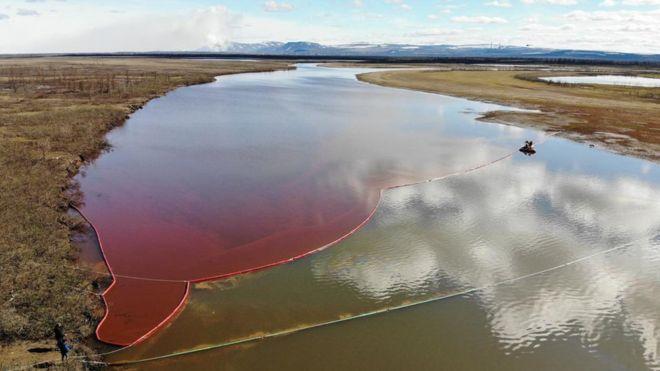
According to BBC, Russia's President Vladimir Putin has declared a state of emergency after 20,000 tonnes of diesel oil leaked into a river within the Arctic Circle.
The spill happened when a fuel tank at a power plant near the Siberian city of Norilsk collapsed last Friday.
The power plant's director Vyacheslav Starostin has been taken into custody until 31 July, but not yet charged.
The plant is owned by a subsidiary of Norilsk Nickel, which is the world's leading nickel and palladium producer.
The Russian Investigative Committee (SK) has launched a criminal case over the pollution and alleged negligence, as there was reportedly a two-day delay in informing the Moscow authorities about the spill.
Ground subsidence beneath the fuel storage tanks is believed to have caused the spill. Arctic permafrost has been melting in exceptionally warm weather for this time of year.
President Putin expressed anger after discovering officials only learnt about the incident on Sunday.
Russian Minister for Emergencies Yevgeny Zinichev told Mr Putin that the Norilsk plant had spent two days trying to contain the spill, before alerting his ministry.
The leaked oil drifted some 12km (7.5 miles) from the accident site, turning long stretches of the Ambarnaya river crimson red.
In a televised video conference on Wednesday, Mr Putin criticised the head of the company over its response.
"Why did government agencies only find out about this two days after the fact?" he asked the subsidiary's chief, Sergei Lipin. "Are we going to learn about emergency situations from social media?"
The region's governor, Alexander Uss, had earlier told President Putin that he became aware of the oil spill on Sunday after "alarming information appeared in social media".
The spill has contaminated a 350 sq km (135 sq mile) area, state media report.
In a statement, Norilsk Nickel said the incident had been reported in a "timely and proper" way.
The state of emergency means extra forces are going to the area to assist with the clean-up operation.
The accident is believed to be the second largest in modern Russian history in terms of volume, an expert from the World Wildlife Fund, Alexei Knizhnikov, told the AFP news agency.
What can be done?
The incident has prompted stark warnings from environmental groups, who say the scale of the spill and geography of the river mean it will be difficult to clean up.
Greenpeace has compared it to the 1989 Exxon Valdez disaster in Alaska.
Oleg Mitvol, former deputy head of Russia's environmental watchdog Rosprirodnadzor, said there had "never been such an accident in the Arctic zone".
He said the clean-up could cost 100bn roubles (£1.2bn; $1.5bn) and take between five and 10 years.
It is not the first time Norilsk Nickel has been involved in oil spillages.
In 2016, it admitted that an accident at one of its plants was responsible for turning a nearby river red.
Minister of Natural Resources Dmitry Kobylkin warned against trying to burn off such a vast quantity of fuel oil.
He proposed trying to dilute the oil with reagents. Only the emergencies ministry with military support could deal with the pollution, he said.
Barges with booms could not contain the slick because the Ambarnaya river was too shallow, he warned.
He suggested pumping the oil on to the adjacent tundra, although President Putin added: "The soil there is probably saturated [with oil] already."
05.06.2020 10:16


 Latest news
Latest news
Latest newsBulgaria Asks NATO to Strengthen Its Defences Amid Black Sea Threats: Sofia Fears Growing Risks to Maritime Shipping
16.Oct.2026
Black Sea Shipping Risks Threaten Bulgaria’s 5 Million Tonnes of Wheat Exports
15.Oct.2026
Georgia’s Foreign Funding and Political Ban Laws Draw Criticism from the Venice Commission
15.Oct.2026
Kazakhstan Promotes a Caspian Green Energy Corridor: Astana Seeks New Routes to the European Market
14.Oct.2026
Inflation in Romania Accelerates to 6.61%: Rising Prices Increase Pressure on Households and the Economy
13.Oct.2026
Can Europe Protect the International Criminal Court from Trump’s Sanctions?
13.Oct.2026
Georgia’s Constitutional Court Continues Case on Banning Opposition Parties: Political Pluralism at Stake
12.Oct.2026
Azerbaijan and Iran Step Up Security Contacts Amid Hijab Protests
12.Oct.2026
Personnel Shortages Complicate Ukrainian Forces’ Rotation: Ukraine Faces Long-Term Challenges on the Front Line
11.Oct.2026
Trump Eases Sanctions on Russian Fuel After Talks with Putin: Kyiv Fears Boost to Moscow’s War Revenues
10.Oct.2026
Putin Seeks to Strengthen Russia’s Influence in the Post-Soviet Space Through the CIS
10.Oct.2026
Russia and the South Caucasus: External Pressure, Political Competition and a Crisis of Trust
10.Oct.2026
Peaceful Settlement Between Armenia and Azerbaijan: Moving from Declarations to Implementation
10.Oct.2026
Moldova Ready to Accept as Many Ukrainians as Necessary if Situation Worsens This Winter
09.Oct.2026
Turkmenistan Turns Avaza into a Regional Diplomatic Hub as Caspian, Central Asian and CIS Agendas Converge
08.Oct.2026