
 17 Oct 2026









Georgian President Zurabishvili: "I Will Stay in Office to Provide Stability During the Transition Period"
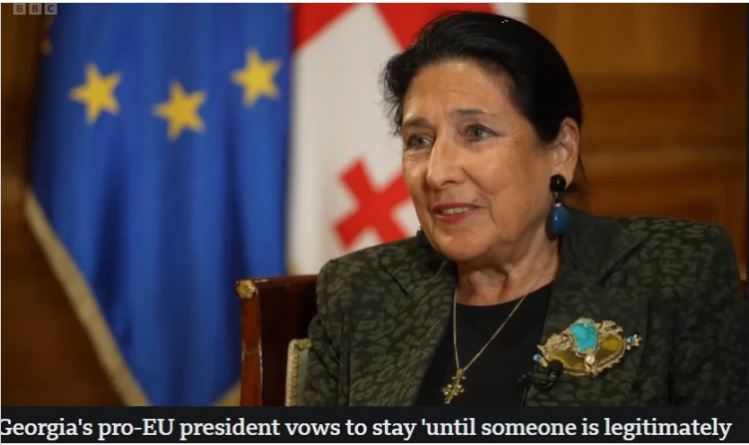
Georgian President Salome Zurabishvili has declared her intention to remain in office during a transition period, citing the country's urgent need for stability amid deep political turmoil. In an interview with the BBC, Zurabishvili criticized the ruling Georgian Dream party and called for early elections to restore the nation’s European trajectory.
"I remain in office because this country needs stability. Everything is falling apart. Under the Georgian Dream's rule, no independent institution remains except for the presidency. All others are dominated by one-party governance, which is increasingly autocratic," Zurabishvili said.
Zurabishvili noted a significant increase in public protests, with demonstrations now spreading beyond the capital, Tbilisi. She highlighted an unprecedented trend of government employees resigning from various ministries and institutions in solidarity with the movement.
"What's new and unusual for Georgia is the emergence of spontaneous protests in cities across the country. Political parties are boycotting parliament, leaving us in a profound crisis. What the people demand on the streets is clear: new elections to bring this country back to its European path," she said.
Zurabishvili proposed a transition period marked by stability and collaboration between political parties and civil society, with the aim of organizing free and fair elections. She emphasized the importance of a European Parliament resolution that also advocates for new elections, along with a forthcoming European Council decision and a technical mission to help ensure credible voting processes.
"This transitional period must be as short and stable as possible. I will remain as president, while a National Council, including political parties and civil society, will assist in addressing the political aspects of the crisis. My role is not to lead the street protests but to ensure stability and preparation for elections," she said.
Asked what would happen if Georgian Dream ignored calls for early elections, Zurabishvili expressed confidence in the resolve of protesters. "What if we ignore them? That’s exactly what people are doing in the streets. Despite violence and force used against them, their determination remains unchanged," she said.
Addressing concerns about her safety and the possibility of arrest, she responded, "I don’t think so. People on the streets are protecting me. The ruling party is increasingly isolated, and it’s in everyone’s interest to ensure a stable transition and new elections."
Zurabishvili insisted that free and fair elections would allow Georgian Dream to retain representation proportional to the public's will, paving the way for a new political landscape.
Zurabishvili underscored the importance of European engagement in resolving the crisis. "The European Parliament’s resolution and the technical mission will provide conditions for free and fair elections. This is a critical step for our country's return to the European path," she concluded.
The political crisis in Georgia continues to deepen as public discontent grows, with the European Union closely monitoring developments ahead of a critical December meeting.
02.12.2024 10:47


 Latest news
Latest news
Latest newsBulgaria Asks NATO to Strengthen Its Defences Amid Black Sea Threats: Sofia Fears Growing Risks to Maritime Shipping
16.Oct.2026
Black Sea Shipping Risks Threaten Bulgaria’s 5 Million Tonnes of Wheat Exports
15.Oct.2026
Georgia’s Foreign Funding and Political Ban Laws Draw Criticism from the Venice Commission
15.Oct.2026
Kazakhstan Promotes a Caspian Green Energy Corridor: Astana Seeks New Routes to the European Market
14.Oct.2026
Inflation in Romania Accelerates to 6.61%: Rising Prices Increase Pressure on Households and the Economy
13.Oct.2026
Can Europe Protect the International Criminal Court from Trump’s Sanctions?
13.Oct.2026
Georgia’s Constitutional Court Continues Case on Banning Opposition Parties: Political Pluralism at Stake
12.Oct.2026
Azerbaijan and Iran Step Up Security Contacts Amid Hijab Protests
12.Oct.2026
Personnel Shortages Complicate Ukrainian Forces’ Rotation: Ukraine Faces Long-Term Challenges on the Front Line
11.Oct.2026
Trump Eases Sanctions on Russian Fuel After Talks with Putin: Kyiv Fears Boost to Moscow’s War Revenues
10.Oct.2026
Putin Seeks to Strengthen Russia’s Influence in the Post-Soviet Space Through the CIS
10.Oct.2026
Russia and the South Caucasus: External Pressure, Political Competition and a Crisis of Trust
10.Oct.2026
Peaceful Settlement Between Armenia and Azerbaijan: Moving from Declarations to Implementation
10.Oct.2026
Moldova Ready to Accept as Many Ukrainians as Necessary if Situation Worsens This Winter
09.Oct.2026
Turkmenistan Turns Avaza into a Regional Diplomatic Hub as Caspian, Central Asian and CIS Agendas Converge
08.Oct.2026