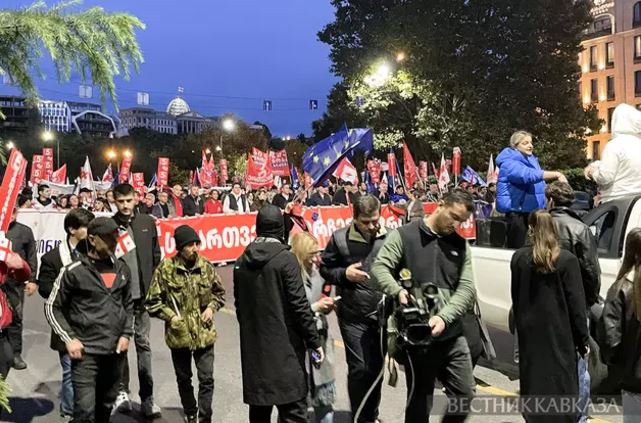
Protests in Georgia: What happened at night?

    A protest that began on the evening of November 28 near the Georgian parliament in the center of Tbilisi escalated into clashes with police officers. The unrest resulted in injuries to both protesters and law enforcement officers as well as numerous arrests.

    The protest broke out after Prime Minister Irakli Kobakhidze's statement regarding the removal of negotiations on Georgia's accession to the EU until 2028 from the agenda. The protest was attended by opposition representatives and their supporters, NGO employees, as well as the country's president Salome Zurabishvili

    According to the Georgian Interior Ministry, the protest went beyond the legal norms on assemblies and demonstrations. The ministry added that, despite repeated calls for calm, protesters clashed with police officers.

    Later, security forces began using pepper spray against the protesters in an attempt to disperse the crowd, but the riots in the capital of Georgia continued. Soon, special forces arrived in the city center.

    After numerous calls to the protesters, security forces began clearing the area on Rustaveli Avenue using water cannons. The protest ended in the morning.

    It is noted that 32 police officers sustained injuries, including head and eyes trauma. Some police officers required surgical assistance.

    It should be added that law enforcement officers detained 43 protesters. An investigation is underway against the detainees under several articles of the Criminal Code of Georgia.

    In the morning, it became known that traffic on Rustaveli Avenue had been restored. Restoration work is underway on the same section.


    © Photo :Varvara Klimenko/Vestnik Kavkaza


    29.11.2024 10:53


Latest news

    Bulgaria Asks NATO to Strengthen Its Defences Amid Black Sea Threats: Sofia Fears Growing Risks to Maritime Shipping

    16.Oct.2026

    Black Sea Shipping Risks Threaten Bulgaria’s 5 Million Tonnes of Wheat Exports

    15.Oct.2026

    Georgia’s Foreign Funding and Political Ban Laws Draw Criticism from the Venice Commission

    15.Oct.2026

    Kazakhstan Promotes a Caspian Green Energy Corridor: Astana Seeks New Routes to the European Market

    14.Oct.2026

    Inflation in Romania Accelerates to 6.61%: Rising Prices Increase Pressure on Households and the Economy

    13.Oct.2026

    Can Europe Protect the International Criminal Court from Trump’s Sanctions?

    13.Oct.2026

    Georgia’s Constitutional Court Continues Case on Banning Opposition Parties: Political Pluralism at Stake

    12.Oct.2026

    Azerbaijan and Iran Step Up Security Contacts Amid Hijab Protests

    12.Oct.2026

    Personnel Shortages Complicate Ukrainian Forces’ Rotation: Ukraine Faces Long-Term Challenges on the Front Line

    11.Oct.2026

    Trump Eases Sanctions on Russian Fuel After Talks with Putin: Kyiv Fears Boost to Moscow’s War Revenues

    10.Oct.2026

    Putin Seeks to Strengthen Russia’s Influence in the Post-Soviet Space Through the CIS

    10.Oct.2026

    Russia and the South Caucasus: External Pressure, Political Competition and a Crisis of Trust

    10.Oct.2026

    Peaceful Settlement Between Armenia and Azerbaijan: Moving from Declarations to Implementation

    10.Oct.2026

    Moldova Ready to Accept as Many Ukrainians as Necessary if Situation Worsens This Winter

    09.Oct.2026

    Turkmenistan Turns Avaza into a Regional Diplomatic Hub as Caspian, Central Asian and CIS Agendas Converge

    08.Oct.2026

All news