
 17 Oct 2026









Armenia’s Pashinyan spills water on his desk, clothes to explain what he is doing in Tavush Province
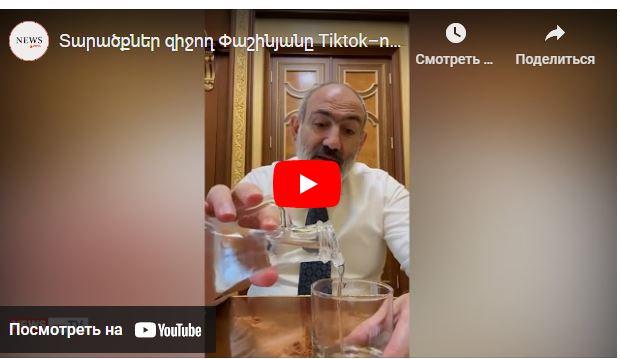
Armenian Prime Minister Nikol Pashinyan dedicated his conversation Tuesday about the state to law, jurisdiction, sovereignty, and territorial integrity.
"These are parts of the trinity because the most important attribute of sovereignty in the conditions of a democratic state is that the people decide the scope of their rights and responsibilities; that is, not others decide what rights and responsibilities the people have, but the people decide," Pashinyan said, noting that it is also important to have an idea of what area these rights and duties operate on.
"This is called jurisdiction in combination with territorial integrity, which essentially makes rights and duties practical and applicable. Sovereignty, law, even statehood without the concretization of the territory are blurred and become scarcely applicable, non-applicable, and even non-viable. That is, the applicability of rights and responsibilities is directly related to the concreteness and territorial integrity of the territory," he said.
To more graphically show what he said, Pashinyan took a vial filled with water, poured the water into a glass, and said: "Imagine that the rights and responsibilities are in a vial. If they are placed in a concrete form, they are applicable and viable, and we can use it to meet our vital needs.
As Pashinyan said this, he took a sip from the water, demonstrating the "use" of rights and responsibilities.
Then, Pashinyan proposed to imagine what would happen if the rights and responsibilities are not enclosed in the form, and poured the water from the vial on his desk.
The water from the desk spilled on Pashinyan's clothes, and he said they become non-vital, blur, and create problems and a feeling of discomfort.
"What we are doing also in the Tavush Province, also in the process of border delimitation and demarcation, also in the peace agenda [with Azerbaijan], has exactly this objective. Within its framework, the range of rights and responsibilities of citizens will be significantly strengthened, this four unity will guarantee the development and existence of our state," said the Armenian PM.
As reported earlier, on April 19, the Armenian and Azerbaijani border delimitation commissions agreed to start border delimitation from Tavush Province of Armenia. The description of the given sections of the border line will be drawn up taking into account the clarification of the coordinates made as a result of geodetic measurements on the site, and this will be worded in a corresponding protocol-description, which must be agreed upon and signed by the two parties before May 15.
The office of the Prime Minister of Armenia had announced that as a result of all this, Azerbaijan will receive 2.5 villages, and Armenia will get a reduction of security risks related to border delimitation. A few hundred meters of the motorway will be changed in the Kirants village section, whereas Voskepar village will not have a motorway problem. After the border delimitation, the armed forces of Armenia and Azerbaijan will withdraw in the area of the four villages, and they will be replaced by the border guards of the two countries.
Residents of Tavush’s border villages have been protesting on the Armenia-Georgia interstate motorway since April 19. They are against the aforesaid version of border delimitation agreed between Armenia and Azerbaijan.


 Latest news
Latest news
Latest newsBulgaria Asks NATO to Strengthen Its Defences Amid Black Sea Threats: Sofia Fears Growing Risks to Maritime Shipping
16.Oct.2026
Black Sea Shipping Risks Threaten Bulgaria’s 5 Million Tonnes of Wheat Exports
15.Oct.2026
Georgia’s Foreign Funding and Political Ban Laws Draw Criticism from the Venice Commission
15.Oct.2026
Kazakhstan Promotes a Caspian Green Energy Corridor: Astana Seeks New Routes to the European Market
14.Oct.2026
Inflation in Romania Accelerates to 6.61%: Rising Prices Increase Pressure on Households and the Economy
13.Oct.2026
Can Europe Protect the International Criminal Court from Trump’s Sanctions?
13.Oct.2026
Georgia’s Constitutional Court Continues Case on Banning Opposition Parties: Political Pluralism at Stake
12.Oct.2026
Azerbaijan and Iran Step Up Security Contacts Amid Hijab Protests
12.Oct.2026
Personnel Shortages Complicate Ukrainian Forces’ Rotation: Ukraine Faces Long-Term Challenges on the Front Line
11.Oct.2026
Trump Eases Sanctions on Russian Fuel After Talks with Putin: Kyiv Fears Boost to Moscow’s War Revenues
10.Oct.2026
Putin Seeks to Strengthen Russia’s Influence in the Post-Soviet Space Through the CIS
10.Oct.2026
Russia and the South Caucasus: External Pressure, Political Competition and a Crisis of Trust
10.Oct.2026
Peaceful Settlement Between Armenia and Azerbaijan: Moving from Declarations to Implementation
10.Oct.2026
Moldova Ready to Accept as Many Ukrainians as Necessary if Situation Worsens This Winter
09.Oct.2026
Turkmenistan Turns Avaza into a Regional Diplomatic Hub as Caspian, Central Asian and CIS Agendas Converge
08.Oct.2026