
 17 Oct 2026









Azerbaijani Red Crescent sends humanitarian aid to Karabakh Armenians
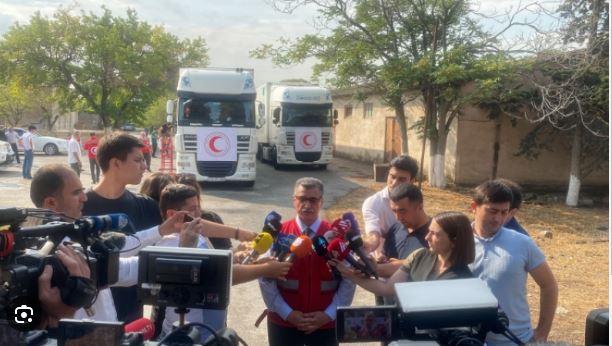
The Azerbaijani Red Crescent Society has sent 40 tons of the humanitarian aid to the Armenian residents of Karabakh. The cargo is supposed to be delivered on the Aghdam-Khankyandi road.
"We hope that the humanitarian aid will be delivered to the addressee in a timely manner without problems. The vehicles are accompanied by flags and emblems of the Red Crescent in accordance with the Law of Azerbaijan "On the Use of Emblems of the Red Cross and Red Crescent and their Protection," the Red Crescent said in a statement.
It is to remind that on August 21, the Board of the Azerbaijani Red Crescent Society, in line with its charter, national legislation, the Geneva Conventions and the Seville Agreements, decided to provide humanitarian assistance to the Armenian residents of the Karabakh region.
In turn, the President of the Azerbaijani Red Crescent Society Novruz Aslan said that the first batch of humanitarian aid sent to Karabakh Armenians today consists of 40 tons of flour products.
He expressed hope that this step will be positively received by the Armenians living in Khankendi and the international community. "If we manage to carry out the evaluation process, we will also be able to deliver other goods they need in the future," Aslan said.
No reaction of the Armenians of Karabakh to this gesture has yet followed. So far, it has been stated at various levels that Karabakh Armenians will not accept any help from Azerbaijan and will not open the road from Aghdam to Karabakh.


 Latest news
Latest news
Latest newsBulgaria Asks NATO to Strengthen Its Defences Amid Black Sea Threats: Sofia Fears Growing Risks to Maritime Shipping
16.Oct.2026
Black Sea Shipping Risks Threaten Bulgaria’s 5 Million Tonnes of Wheat Exports
15.Oct.2026
Georgia’s Foreign Funding and Political Ban Laws Draw Criticism from the Venice Commission
15.Oct.2026
Kazakhstan Promotes a Caspian Green Energy Corridor: Astana Seeks New Routes to the European Market
14.Oct.2026
Inflation in Romania Accelerates to 6.61%: Rising Prices Increase Pressure on Households and the Economy
13.Oct.2026
Can Europe Protect the International Criminal Court from Trump’s Sanctions?
13.Oct.2026
Georgia’s Constitutional Court Continues Case on Banning Opposition Parties: Political Pluralism at Stake
12.Oct.2026
Azerbaijan and Iran Step Up Security Contacts Amid Hijab Protests
12.Oct.2026
Personnel Shortages Complicate Ukrainian Forces’ Rotation: Ukraine Faces Long-Term Challenges on the Front Line
11.Oct.2026
Trump Eases Sanctions on Russian Fuel After Talks with Putin: Kyiv Fears Boost to Moscow’s War Revenues
10.Oct.2026
Putin Seeks to Strengthen Russia’s Influence in the Post-Soviet Space Through the CIS
10.Oct.2026
Russia and the South Caucasus: External Pressure, Political Competition and a Crisis of Trust
10.Oct.2026
Peaceful Settlement Between Armenia and Azerbaijan: Moving from Declarations to Implementation
10.Oct.2026
Moldova Ready to Accept as Many Ukrainians as Necessary if Situation Worsens This Winter
09.Oct.2026
Turkmenistan Turns Avaza into a Regional Diplomatic Hub as Caspian, Central Asian and CIS Agendas Converge
08.Oct.2026