
 17 Oct 2026









Exclusive: Zelensky calls Putin ‘weak’ and says Russian President’s power is ‘crumbling’
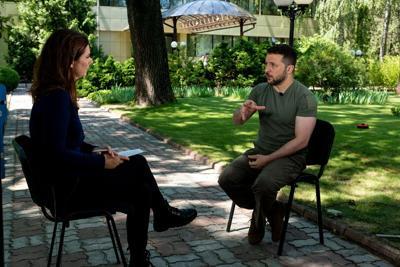
cnn: Editor’s Note: Erin Burnett’s full interview with Volodymyr Zelensky airs Wednesday July 5 at 7 p.m. ET.
Vladimir Putin’s response to the armed Wagner rebellion was “weak” and the Russian President is losing control of his own people, Ukrainian President Volodymyr Zelensky told CNN in an exclusive interview.
Putin faced the greatest threat to his authority in two decades last month when the head of the Wagner paramilitary group, Yevgeny Prigozhin, launched a short-lived uprising, claiming control of military facilities in two Russian cities and marching toward Moscow before he agreed to stand down.
“We see Putin’s reaction. It’s weak,” Zelensky told CNN’s Erin Burnett in Odesa, in an interview taped on Sunday.
“Firstly, we see he doesn’t control everything. Wagner’s moving deep into Russia and taking certain regions shows how easy it is to do. Putin doesn’t control the situation in the regions.”
“All that vertical of power he used to have is just crumbling down.”
Some Russians cheered on Wagner fighters as Prigozhin led the unprecedented challenge to Putin’s authority. Video geolocated and verified by CNN showed crowds cheering as the Wagner boss’ vehicle departed the southern city of Rostov-on-Don on June 24.
Zelensky said Ukrainian intelligence reports showed the Kremlin was measuring support for Prigozhin, and he claimed that half of Russia supported the Wagner boss and the paramilitary group’s mutiny.
The interview with Zelensky comes at a critical time – not only in the wake of Prigozhin’s failed insurrection, but also weeks into Ukraine’s slow push to recapture territory occupied by Russia.
That effort has come under intense scrutiny from Western allies and on Saturday a US official told CNN the head of the US Central Intelligence Agency (CIA), Bill Burns, had visited Kyiv recently and met with Zelensky and Ukrainian intelligence officials.
Zelensky told CNN he was “surprised” to see his meeting with Burns reported in the media. “My communication with the CIA chief should always be behind the scenes,” he said. “We discuss important things – what Ukraine needs and how Ukraine is prepared to act.”
Burns, a veteran diplomat, has become a trusted interlocutor in Kyiv, and has made several trips to Ukraine during the war.
“We don’t have any secrets from CIA, because we have good relations, and our intelligence services talk with each other,” Zelensky said.
“The situation is pretty straightforward. We have good relations with the CIA chief and we are talking. I told him about all the important things related to the battlefield which we need.”
Burns traveled to Kyiv before Prigozhin’s rebellion, which was not a topic of discussion, the US official told CNN.
Speaking at a news conference in Kyiv Saturday, Zelensky said Prigozhin’s rebellion had “greatly affected Russian power on the battlefield” and could be beneficial to Ukraine’s counteroffensive.
While the thrust of Kyiv’s efforts have focused on recapturing territory in the south and east of Ukraine, Zelensky told Burnett that his ultimate goal was to liberate Crimea, the peninsula annexed by Russia in 2014 in violation of international law.
“We cannot imagine Ukraine without Crimea. And while Crimea is under the Russian occupation, it means only one thing: the war is not over yet,” he said.
Asked whether there was any scenario under which there could be peace without Crimea, Zelensky said: “It will not be victory then.”
CNN’s Gul Tuysuz contributed to this story.


 Latest news
Latest news
Latest newsBulgaria Asks NATO to Strengthen Its Defences Amid Black Sea Threats: Sofia Fears Growing Risks to Maritime Shipping
16.Oct.2026
Black Sea Shipping Risks Threaten Bulgaria’s 5 Million Tonnes of Wheat Exports
15.Oct.2026
Georgia’s Foreign Funding and Political Ban Laws Draw Criticism from the Venice Commission
15.Oct.2026
Kazakhstan Promotes a Caspian Green Energy Corridor: Astana Seeks New Routes to the European Market
14.Oct.2026
Inflation in Romania Accelerates to 6.61%: Rising Prices Increase Pressure on Households and the Economy
13.Oct.2026
Can Europe Protect the International Criminal Court from Trump’s Sanctions?
13.Oct.2026
Georgia’s Constitutional Court Continues Case on Banning Opposition Parties: Political Pluralism at Stake
12.Oct.2026
Azerbaijan and Iran Step Up Security Contacts Amid Hijab Protests
12.Oct.2026
Personnel Shortages Complicate Ukrainian Forces’ Rotation: Ukraine Faces Long-Term Challenges on the Front Line
11.Oct.2026
Trump Eases Sanctions on Russian Fuel After Talks with Putin: Kyiv Fears Boost to Moscow’s War Revenues
10.Oct.2026
Putin Seeks to Strengthen Russia’s Influence in the Post-Soviet Space Through the CIS
10.Oct.2026
Russia and the South Caucasus: External Pressure, Political Competition and a Crisis of Trust
10.Oct.2026
Peaceful Settlement Between Armenia and Azerbaijan: Moving from Declarations to Implementation
10.Oct.2026
Moldova Ready to Accept as Many Ukrainians as Necessary if Situation Worsens This Winter
09.Oct.2026
Turkmenistan Turns Avaza into a Regional Diplomatic Hub as Caspian, Central Asian and CIS Agendas Converge
08.Oct.2026