
 17 Oct 2026









Parties agreed to meet in week following results of trilateal meeting in Moscow
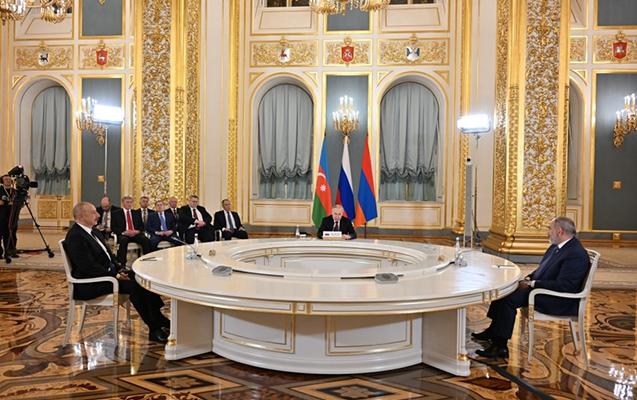
Expectations about the signing of agreements on a peace treaty and the opening of communications at the Putin-Aliyev-Pashinyan meeting were not met. Instead, there was another presentation of mutual claims.
A negative tone was set by the skirmish between Aliyev and Pashinyan at a meeting of the Supreme Eurasian Economic Council in the presence of the heads of state.
After that, Putin-Pashinyan and Putin-Aliyev held bilateral meetings, at which Putin failed to resolve the contradictions between the parties.
According to him, unresolved issues remained following the face-to-face meetings between the parties. However, they are purely "technical" in nature and, first of all, this is terminology.
"Of course, behind these terms there should be an accurate understanding of the realities and events that will follow the signing of the relevant documents. But, to our thinking, these are surmountable obstacles. By and large, they do not exist," Putin said.
The Putin-Aliyev-Pashinyan trilateral meeting lasted until 23 o'clock Moscow time (until 24:00 Baku time), but yielded no results.
Summing up, Putin was clearly trying to smooth out the contradictions, calling on the parties to "clarify the terms." At the same time, he stressed that the parties agreed on "fundamental issues" - mutual recognition of territorial integrity.
Judging by Pashinyan's remarks at the Council meeting, he was "surprised" by Aliyev's statement that Russia is interested in opening the Zangezur corridor. "This is news to me," Pashinyan said in a tone as if he had revealed the fact of his ally's betrayal.
Further, he actually accused Russia of failing to fulfill its obligations to ensure free movement along the Lachin corridor. There should be no one in this corridor except Russian peacekeepers, but Azerbaijan illegally blocked it. He repeated this thesis twice: at the Council meeting and at the bilateral meeting with Putin.
Touching upon the Zangezur corridor, Putin remarked: "Regarding the unblocking of transport communications – rail, and possibly the construction of highways – our position remains unchanged."
"And now we are in bilateral contact with the Azerbaijani delegation and we have said this. But I must say that the Azerbaijani side also confirms that Azerbaijan has no changes in this regard, they recognize Armenia's full sovereignty over this territory without any options, and some double, triple interpretation of everything related to the possible unblocking of transport links has no grounds," said Putin.
The Russian President also rejected Pashinyan 's claims about Lachin with the following phrase:
"You know our position regarding the Lachin corridor. We have never changed our position on this. And you know that in discussions with both our Armenian friends and Azerbaijan, we have always adhered to this position and are now adhering to it. Everything should be in accordance with the spirit and letter of this trilateral statement of ours. Our position has not changed here," Putin said, adding that an agreement had been reached that the Deputy Prime Ministers of the three countries would meet in a week and eliminate "technical issues."
Note that Aliyev and Pashinyan made no statements following the meeting, which also indicates a tense situation.
In turn, Russian Deputy Prime Minister Alexey Overchuk told reporters that border crossing issues remain unresolved. "We are talking about the procedure for crossing the border between Azerbaijan and Armenia, how border and customs control will be carried out," Overchuk said, adding that after the talks of the Deputy Prime Ministers, the leaders of the three countries will decide whether a new meeting is needed.


 Latest news
Latest news
Latest newsBulgaria Asks NATO to Strengthen Its Defences Amid Black Sea Threats: Sofia Fears Growing Risks to Maritime Shipping
16.Oct.2026
Black Sea Shipping Risks Threaten Bulgaria’s 5 Million Tonnes of Wheat Exports
15.Oct.2026
Georgia’s Foreign Funding and Political Ban Laws Draw Criticism from the Venice Commission
15.Oct.2026
Kazakhstan Promotes a Caspian Green Energy Corridor: Astana Seeks New Routes to the European Market
14.Oct.2026
Inflation in Romania Accelerates to 6.61%: Rising Prices Increase Pressure on Households and the Economy
13.Oct.2026
Can Europe Protect the International Criminal Court from Trump’s Sanctions?
13.Oct.2026
Georgia’s Constitutional Court Continues Case on Banning Opposition Parties: Political Pluralism at Stake
12.Oct.2026
Azerbaijan and Iran Step Up Security Contacts Amid Hijab Protests
12.Oct.2026
Personnel Shortages Complicate Ukrainian Forces’ Rotation: Ukraine Faces Long-Term Challenges on the Front Line
11.Oct.2026
Trump Eases Sanctions on Russian Fuel After Talks with Putin: Kyiv Fears Boost to Moscow’s War Revenues
10.Oct.2026
Putin Seeks to Strengthen Russia’s Influence in the Post-Soviet Space Through the CIS
10.Oct.2026
Russia and the South Caucasus: External Pressure, Political Competition and a Crisis of Trust
10.Oct.2026
Peaceful Settlement Between Armenia and Azerbaijan: Moving from Declarations to Implementation
10.Oct.2026
Moldova Ready to Accept as Many Ukrainians as Necessary if Situation Worsens This Winter
09.Oct.2026
Turkmenistan Turns Avaza into a Regional Diplomatic Hub as Caspian, Central Asian and CIS Agendas Converge
08.Oct.2026