
 17 Oct 2026









White House On Second Democracy Summit: "If You Can Demonstrate Progress, Biden Wants Everyone In The Room"
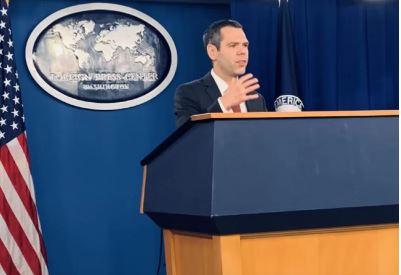
A senior aide to U.S. President Joe Biden on Wednesday made it clear that the White House “wants everyone in the room" during the second Democracy Summit scheduled for next year, if there’s demonstrated political will, TURAN's Washington correspondent reports.
"... If you can demonstrate progress, at the end of the day, President Biden wants everyone in the room," Rob Berschinski, special assistant to the president, said in response to TURAN's questions.
Berschinski, who is also senior director for human rights on the National Security Council, was speaking to reporters during a briefing organized by the State Department's Washington Foreign Press Center on the “Year of Action” following the first Democracy Summit, and preview the upcoming Summit which aims to strengthen democratic institutions, tackle corruption, and defend human rights.
"... The message we gave all of our partners, including those who were invited to the first summit, after it occurred, was what we want to see is active participation under the themes that the summit covers: strengthening democracy wherever you are on the spectrum of lived reality in terms of your governing structure, protecting human rights, doing more to fight corruption. That’s true of those we invited; it’s true of those we didn’t" Berschinski said when asked by TURAN's correspondent whether countries such as Azerbaijan, Turkey, and others, still had a chance to be invited to the upcoming Summit.
"We have cast a very wide net and we sent the message to those that weren’t invited that we have an open-door policy," he said, adding that Washington was not making specific demands.
"There wasn’t a checklist. But we did make clear that we want to enter into a dialogue and that, at the end of the day, our goal is to have everyone there if there’s demonstrated political will," Berschinski said.
Biden gathered more than 100 world leaders during the inaugural summit on December 9 and 10, 2021, urging world leaders to “lock arms” to bolster democracy and prevent a “backward slide” from continuing.
The second Summit, which is scheduled for March 29 and 30, will be co-hosted by Costa Rica, the Netherlands, South Korea and Zambia.
Berschinski said, Washington's intention is "to show the many ways that democracies around the world are delivering and developing solutions to all of the world’s most pressing challenges: whether countering aggression, addressing the climate crisis, global health security, or feeding the world."
As for the format, the White House is planning to assemble world leaders in a virtual plenary format on the 29th, followed by in-person gatherings in each co-host country with representatives of governments and civil society and the private sector.
"We’re also planning a number of meetings that will precede the 29th with additional programming and urging all of our government and non-governmental partners to host events as well. So I think you’re going to see quite a bit of action in the leadup to the formal dates on the 29th and 30th of March," he said.
He went on to add, "Our intention is to have summit sessions that focus on many of the key themes that we highlighted last year, but I’ll name just a few: supporting free and independent media, fighting corruption, bolstering democratic reformers, advancing technology for democracy, and defending free and fair elections and political processes, among others."
The summit will also highlight the work of what the White House has been calling Democracy Cohorts. "These are multistakeholder thematic groups – and by multistakeholder, I mean they include both governments and NGOs and, in some cases, corporations that have launched around the world on issues like financial transparency, supporting human rights defenders, countering internet shutdowns, supporting the rights of women and girls. Each of these groups has brought together subsets of our invitees to the Summit for Democracy," Berschinski described.
Asked by TURAN about achievements from the first summit, Berschinski said, the participants made over 700 different commitments, and "many of them are following through in multiple ways."
"And I bring commitments up in my bilateral engagements, the President brings them up in his, the Secretary of State, the National Security Advisor. So we’re having a dialogue and, yes, I think we’re seeing significant progress, much of which we’ll highlight in March," he said.
TURAN's correspondent also asked Berschinski whether he thought Russia's Putin, through his war in Ukraine, jeopardized progress that’s being made on the democracy front.
"No," he said, adding, "moreover, through this devastating and unnecessary war, the Ukrainian people are really showing that courage to defend the front lines of freedom lives on. And that’s why we in the U.S. Government and so many around the world are doing so much to support them."
Alex Raufoglu
Washington D.C.


 Latest news
Latest news
Latest newsBulgaria Asks NATO to Strengthen Its Defences Amid Black Sea Threats: Sofia Fears Growing Risks to Maritime Shipping
16.Oct.2026
Black Sea Shipping Risks Threaten Bulgaria’s 5 Million Tonnes of Wheat Exports
15.Oct.2026
Georgia’s Foreign Funding and Political Ban Laws Draw Criticism from the Venice Commission
15.Oct.2026
Kazakhstan Promotes a Caspian Green Energy Corridor: Astana Seeks New Routes to the European Market
14.Oct.2026
Inflation in Romania Accelerates to 6.61%: Rising Prices Increase Pressure on Households and the Economy
13.Oct.2026
Can Europe Protect the International Criminal Court from Trump’s Sanctions?
13.Oct.2026
Georgia’s Constitutional Court Continues Case on Banning Opposition Parties: Political Pluralism at Stake
12.Oct.2026
Azerbaijan and Iran Step Up Security Contacts Amid Hijab Protests
12.Oct.2026
Personnel Shortages Complicate Ukrainian Forces’ Rotation: Ukraine Faces Long-Term Challenges on the Front Line
11.Oct.2026
Trump Eases Sanctions on Russian Fuel After Talks with Putin: Kyiv Fears Boost to Moscow’s War Revenues
10.Oct.2026
Putin Seeks to Strengthen Russia’s Influence in the Post-Soviet Space Through the CIS
10.Oct.2026
Russia and the South Caucasus: External Pressure, Political Competition and a Crisis of Trust
10.Oct.2026
Peaceful Settlement Between Armenia and Azerbaijan: Moving from Declarations to Implementation
10.Oct.2026
Moldova Ready to Accept as Many Ukrainians as Necessary if Situation Worsens This Winter
09.Oct.2026
Turkmenistan Turns Avaza into a Regional Diplomatic Hub as Caspian, Central Asian and CIS Agendas Converge
08.Oct.2026