
 17 Oct 2026









Ilham Aliyev: Armenia hinders the visit of the UNESCO mission to the region
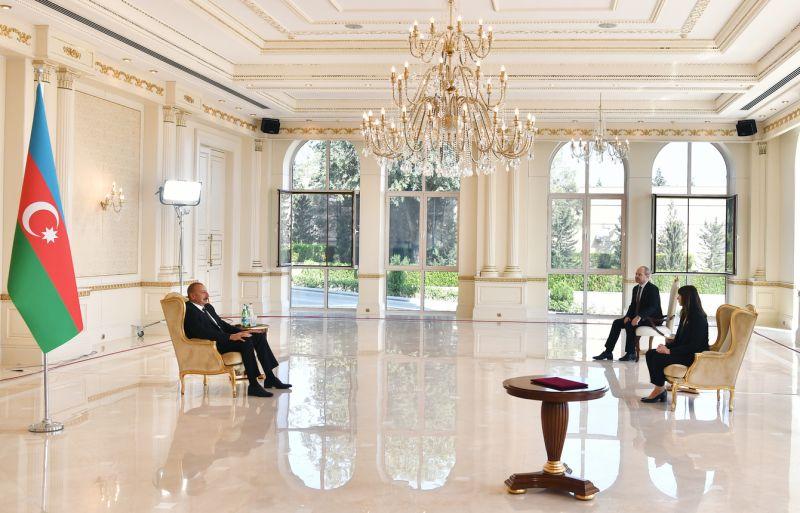
President Ilham Aliyev today received the newly appointed UN Resident Coordinator Vladanka Andreeva.
Welcoming the guest, Aliyev noted that four UN Security Council resolutions adopted in 1993 demanding the immediate and complete withdrawal of Armenian troops from the internationally recognized territories of Azerbaijan were not implemented. This is despite the fact that three out of five permanent members of the UN Security Council are co-chairs of the OSCE Minsk Group.
“However, in 28 years the Minsk Group has missed many opportunities. Many times I raised the issue of imposing sanctions against Armenia, hoping that this could prevent a war, because we wanted to resolve the issue peacefully,” Aliyev said.
If the sanctions were applied, then the Second Karabakh War could have been avoided. “Therefore, the responsibility for the war lies not only with Armenia, but also with those who cannot or do not want to force her to comply with the norms of international law.
Therefore, Azerbaijan itself complied with all these UN Security Council resolutions. We restored justice and the norms of international law and we acted in accordance with Article 51 of the UN Charter, which recognizes the country's right to self-defense,” Aliyev said.
“Now that the war is over, the conflict has been resolved, there is nothing more to talk about. Now we need to look to the future, and our main task is to rebuild the destroyed areas. Of course, we hope for further cooperation with the UN on these issues, on the humanitarian situation, we need more interaction with UN institutions,” Aliyev continued.
He also drew attention to the fact that several years ago Azerbaijan invited UNESCO to come and see what is happening in the occupied territories. “We asked UNESCO to assess the damage caused to our historical monuments by the Armenian invaders, but they refused. UNESCO representatives said that UNESCO does not interfere in political affairs. However, after the war, we received signals from UNESCO that they want to come,” Aliyev said.
Azerbaijan agreed to visit the UNESCO mission. “According to the latest information, the mission has already been formed, but now Armenia is protesting. Therefore, the mission is still postponed,” Aliyev said.
Azerbaijan also maintains contacts with the UN High Commissioner for Refugees. “We plan to return all former IDPs to the liberated territories as soon as possible. However, the main problem is complete devastation and mines. “Our main goal is, together with the UN and its structures, to achieve the restoration of the liberated lands. We hope that your office in Baku will actively participate in this,” Aliyev said.
Andreeva expressed the hope that the trilateral statement signed on November 10 would give impetus to the establishment of lasting peace in the region. “In December, we supported your government's assessments of the needs of the Karabakh region and immediately raised $ 1 million for demining work in six districts. We will continue to support national deminers, as this is a priority,” said the UN Resident Coordinator.
The UN is also working with the World Bank, the European Union and other partners to create a fund to coordinate and support ANAMA and conduct mine clearance to the highest standards. “We are committed to supporting efforts to ensure the safe and dignified return of internally displaced persons to the region. On March 1, we signed a new Framework Document on UN Cooperation with Azerbaijan, setting big tasks for the next five years,” Andreeva continued.
The UN would also like to support government initiatives to build a greener economy and strengthen the capacity of health, social protection, education and justice institutions,” Andreeva said.


 Latest news
Latest news
Latest newsBulgaria Asks NATO to Strengthen Its Defences Amid Black Sea Threats: Sofia Fears Growing Risks to Maritime Shipping
16.Oct.2026
Black Sea Shipping Risks Threaten Bulgaria’s 5 Million Tonnes of Wheat Exports
15.Oct.2026
Georgia’s Foreign Funding and Political Ban Laws Draw Criticism from the Venice Commission
15.Oct.2026
Kazakhstan Promotes a Caspian Green Energy Corridor: Astana Seeks New Routes to the European Market
14.Oct.2026
Inflation in Romania Accelerates to 6.61%: Rising Prices Increase Pressure on Households and the Economy
13.Oct.2026
Can Europe Protect the International Criminal Court from Trump’s Sanctions?
13.Oct.2026
Georgia’s Constitutional Court Continues Case on Banning Opposition Parties: Political Pluralism at Stake
12.Oct.2026
Azerbaijan and Iran Step Up Security Contacts Amid Hijab Protests
12.Oct.2026
Personnel Shortages Complicate Ukrainian Forces’ Rotation: Ukraine Faces Long-Term Challenges on the Front Line
11.Oct.2026
Trump Eases Sanctions on Russian Fuel After Talks with Putin: Kyiv Fears Boost to Moscow’s War Revenues
10.Oct.2026
Putin Seeks to Strengthen Russia’s Influence in the Post-Soviet Space Through the CIS
10.Oct.2026
Russia and the South Caucasus: External Pressure, Political Competition and a Crisis of Trust
10.Oct.2026
Peaceful Settlement Between Armenia and Azerbaijan: Moving from Declarations to Implementation
10.Oct.2026
Moldova Ready to Accept as Many Ukrainians as Necessary if Situation Worsens This Winter
09.Oct.2026
Turkmenistan Turns Avaza into a Regional Diplomatic Hub as Caspian, Central Asian and CIS Agendas Converge
08.Oct.2026