
 17 Oct 2026









As hatred festers, some Armenians and Azerbaijanis fight for friendship
After the war, a number of new grassroots initiatives have emerged bringing together Armenians and Azerbaijanis who want to try to build, or rebuild, ties. Post-War Report.
In the months following last year’s war, hatred between Armenians and Azerbaijanis has only grown. Interethnic friendships have been severed, former liberals have turned nationalist and Caucasus social media has become a wasteland of insults and racism.
But in this toxic environment, some Armenians and Azerbaijanis are fighting back. A handful of new social media initiatives have emerged allowing people from both sides to talk to one another with the goal of dialogue and understanding rather than winning arguments.
“During the war I ‘met’ Azerbaijanis on social media for the first time and I realized that I don’t know anything about these people, I was just automatically afraid of them,” said Anahit Baghdasaryan, a 30-year-old tour guide in Dzoraghbyur, just outside Yerevan. “Then, obviously, it was impossible to have conversations.”
But after the war she got more curious about the Azerbaijani perspective, and a friend invited her to a closed Facebook group, Kavkazskiy Perekrestok (Russian for “Caucasus Crossroads”). Created in January, it now has more than 1,000 members and features multiple posts a day ranging from serious discussions about the conflict to self-deprecating memes and simply pretty pictures from Baku and Yerevan, which gather dozens of likes from users of both nationalities.
“I immediately jumped at the chance” to join the group, Baghdasaryan told Eurasianet. “Every day the group has more and more people, and the tone is more and more calm and friendly. This group is a break from the rest of Facebook, where it’s only hate and insults.”
The friendly tone isn’t a given. The group has eight moderators, evenly distributed between Armenians and Azerbaijanis, and there is a long list of rules. Members can only invite people “whom you know personally and whose peaceful approach is certain.” Users are required not to quibble about place names or flags in profile photos: “There was just a war, and people support ‘their’ side. This is normal.” Comments are required to be respectful, and avoid “insults, vulgarity, personal attacks, and stoking nationalism.”
Facebook even shut down an earlier version of the group because comments got out of control. The earlier group also was the subject of a hit piece on Sputnik Armenia that accused its Armenian participants of being too solicitous toward Azerbaijanis. But a new group of organizers and moderators reformed it.
“It’s not easy to make sure all the rules are being followed in such a complex group and at the same time remain impartial,” the moderators said in a joint response to written questions from Eurasianet. “People get tired and burnt out” and new moderators regularly replace them.
The efforts have paid off, though.
“This group is the only place on the social networks where both Armenians and Azerbaijanis can free themselves from any prejudices towards each other,” said another active user, Elchin Karimov, a 32-year-old Azerbaijani now living in Canada and working as a business consultant. He joined because he is “tired of this conflict, of this hatred towards Armenians and their hatred towards my people,” he told Eurasianet.
“After the war, I finally overcame any last prejudices toward our neighbor and seeing Armenians craving peace and friendship made me believe even more that our two nations are 99 percent the same,” Karimov said. “I hope my children, who are born abroad, will witness this peace as I am trying to raise them without hate or prejudice towards anyone – something that no one taught me in school and I still have to learn myself.”
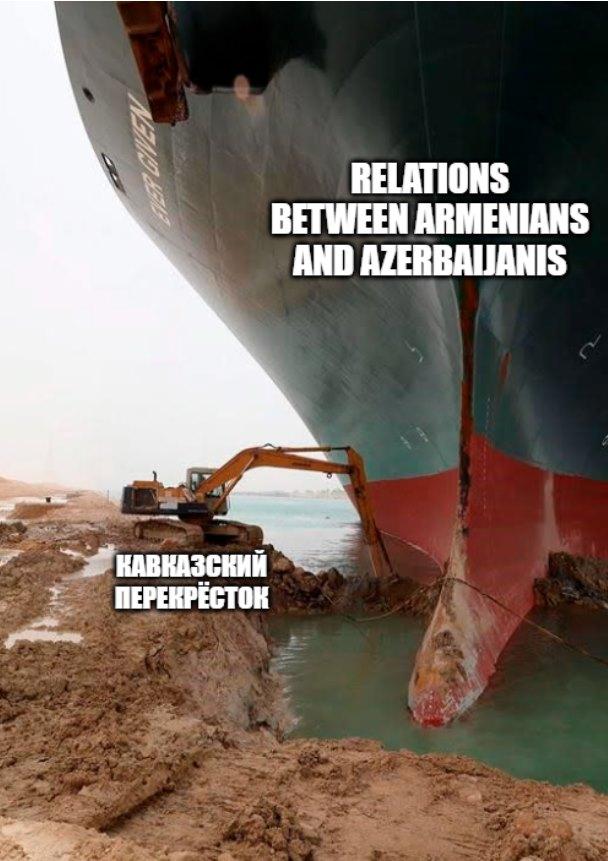 A meme about Kavkazskiy Perekrestok


 Latest news
Latest news
Latest newsBulgaria Asks NATO to Strengthen Its Defences Amid Black Sea Threats: Sofia Fears Growing Risks to Maritime Shipping
16.Oct.2026
Black Sea Shipping Risks Threaten Bulgaria’s 5 Million Tonnes of Wheat Exports
15.Oct.2026
Georgia’s Foreign Funding and Political Ban Laws Draw Criticism from the Venice Commission
15.Oct.2026
Kazakhstan Promotes a Caspian Green Energy Corridor: Astana Seeks New Routes to the European Market
14.Oct.2026
Inflation in Romania Accelerates to 6.61%: Rising Prices Increase Pressure on Households and the Economy
13.Oct.2026
Can Europe Protect the International Criminal Court from Trump’s Sanctions?
13.Oct.2026
Georgia’s Constitutional Court Continues Case on Banning Opposition Parties: Political Pluralism at Stake
12.Oct.2026
Azerbaijan and Iran Step Up Security Contacts Amid Hijab Protests
12.Oct.2026
Personnel Shortages Complicate Ukrainian Forces’ Rotation: Ukraine Faces Long-Term Challenges on the Front Line
11.Oct.2026
Trump Eases Sanctions on Russian Fuel After Talks with Putin: Kyiv Fears Boost to Moscow’s War Revenues
10.Oct.2026
Putin Seeks to Strengthen Russia’s Influence in the Post-Soviet Space Through the CIS
10.Oct.2026
Russia and the South Caucasus: External Pressure, Political Competition and a Crisis of Trust
10.Oct.2026
Peaceful Settlement Between Armenia and Azerbaijan: Moving from Declarations to Implementation
10.Oct.2026
Moldova Ready to Accept as Many Ukrainians as Necessary if Situation Worsens This Winter
09.Oct.2026
Turkmenistan Turns Avaza into a Regional Diplomatic Hub as Caspian, Central Asian and CIS Agendas Converge
08.Oct.2026