
 17 Oct 2026









Putin holds video conference with leaders of France, Germany
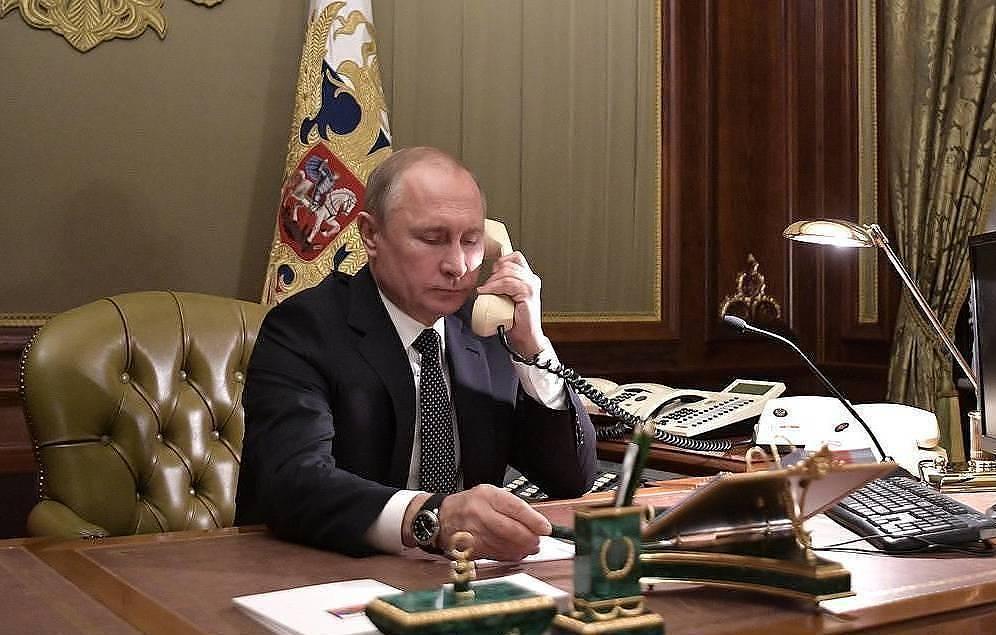
Russia is ready to resume cooperation with the European Union is it demonstrates reciprocal interest, the Kremlin press service quoted Russian President Vladimir Putin as saying during videoconference talks with German Chancellor Angela Merkel and French President Emmanuel Macron on Tuesday.
In a telephone conversation with European Council President Charles Michel on March 22, the Russian president said that the unsatisfactory situation in Russia-EU relations had stemmed from the partners’ non-constructive and even confrontational policy. The Russian side stressed its readiness to resume cooperation with the European Union if Brussels also wanted it. EU foreign policy chief Josep Borrell said earlier that Russia was a dangerous neighbor to the European Union but channels of communications with it should be maintained all the same. He claimed that Russia had embarked on a path of confrontation with the European Union.
"The leaders discussed the situation in relations between Russia and the European Union. The Russian side once again said it is ready to resume normal depoliticized cooperation with the European Union if reciprocal interest is demonstrated," the Kremlin said.
The leaders also addressed the situation in Ukraine, Belarus, Syria and Libya, as well as other international issues.
During the talks, Putin stressed the inadmissibility of meddling with Belarus’ domestic affairs, the Kremlin press service said
"When discussing the situation in Belarus, Vladimir Putin stressed the inadmissibility of foreign interference into domestic affairs of a sovereign state," it said.
Sputnik V prospects
Possible supplies of the Russian Sputnik V coronavirus vaccine to the European Union were among the topics discussed by Russian President Vladimir Putin, German Chancellor Angela Merkel and French President Emmanuel Macron, the Kremlin press service said.
"Special attention was focused on the task to consolidate efforts to combat the common threat - the coronavirus pandemic. In this context, the leaders discussed measures to prevent further spread of the disease," the Kremlin said.
The leaders also looked at "prospects for the registration of the Russian Sputnik V vaccine in the European Union and its possible supplies and joint production in EU countries," it said.
EU’s Internal Market Commissioner Thierry Breton said on March 21 that the European Union did not need Russia’s Sputnik V. Commenting of such words about the Russian vaccine, Putin stressed that Russia never imposed anything on anyone but such statements made one think that EU officials were more interested in supporting certain companies rather than their nationals. Putin said earlier that in terms of combating the coronavirus pandemic "only consolidated efforts can help attain a desired result across the globe and the result must be really global."
The Kremlin earlier slammed Macron’s statement of March 25 that Russia and China were allegedly using their coronavirus vaccines as an instrument of influence. Putin’s press secretary Dmitry Peskov stressed that Russia was a responsible member of the international community and never sought to politicize vaccine-related topics or use the vaccine as an instrument of influence.
Navalny case
During his conversation with German Chancellor Angela Merkel and French President Emmanuel Macron, Putin provided explanations on the situation around blogger Alexey Navalny, the press service said
"In relation to the issue of A. Navalny raised by partners appropriate explanations of objective circumstances of the case were given," the Kremlin noted.
It was noted that overall the talks were conducted in a business-like and sincere atmosphere, it was agreed upon continuing joint work on the entire relevant agenda.
Navalny was rushed to a local hospital in the Siberian city of Omsk on August 20 after collapsing on a Moscow-bound flight from Tomsk. Later, he was airlifted to Berlin and admitted to the Charite hospital. On September 2, Berlin claimed that having examined Navalny’s test samples, German government toxicologists had come to the conclusion that the blogger had been affected by a toxic agent belonging to the Novichok family. Kremlin Spokesman Dmitry Peskov repeatedly emphasized that Russia was ready for comprehensive cooperation with Germany and pointed out that no poisonous substances had been detected in Navalny’s system prior to his transfer to Berlin.
The blogger who received two suspended sentences for embezzlement was placed on the wanted list for repeated violations of rules of his suspended sentence in the Yves Rocher case. On January 17, he was detained at Moscow’s Sheremetyevo airport having arrived from Berlin. On February 2, Moscow’s Simonovsky District Court converted Alexey Navalny’s suspended sentence to 3 years and 6 months in a medium-security prison. According to his lawyer, the blogger will spend slightly over two and a half years at a penal colony. To serve his sentence, he was transferred to penal colony No. 2 in Pokrov from the Kolchugino detention facility.


 Latest news
Latest news
Latest newsBulgaria Asks NATO to Strengthen Its Defences Amid Black Sea Threats: Sofia Fears Growing Risks to Maritime Shipping
16.Oct.2026
Black Sea Shipping Risks Threaten Bulgaria’s 5 Million Tonnes of Wheat Exports
15.Oct.2026
Georgia’s Foreign Funding and Political Ban Laws Draw Criticism from the Venice Commission
15.Oct.2026
Kazakhstan Promotes a Caspian Green Energy Corridor: Astana Seeks New Routes to the European Market
14.Oct.2026
Inflation in Romania Accelerates to 6.61%: Rising Prices Increase Pressure on Households and the Economy
13.Oct.2026
Can Europe Protect the International Criminal Court from Trump’s Sanctions?
13.Oct.2026
Georgia’s Constitutional Court Continues Case on Banning Opposition Parties: Political Pluralism at Stake
12.Oct.2026
Azerbaijan and Iran Step Up Security Contacts Amid Hijab Protests
12.Oct.2026
Personnel Shortages Complicate Ukrainian Forces’ Rotation: Ukraine Faces Long-Term Challenges on the Front Line
11.Oct.2026
Trump Eases Sanctions on Russian Fuel After Talks with Putin: Kyiv Fears Boost to Moscow’s War Revenues
10.Oct.2026
Putin Seeks to Strengthen Russia’s Influence in the Post-Soviet Space Through the CIS
10.Oct.2026
Russia and the South Caucasus: External Pressure, Political Competition and a Crisis of Trust
10.Oct.2026
Peaceful Settlement Between Armenia and Azerbaijan: Moving from Declarations to Implementation
10.Oct.2026
Moldova Ready to Accept as Many Ukrainians as Necessary if Situation Worsens This Winter
09.Oct.2026
Turkmenistan Turns Avaza into a Regional Diplomatic Hub as Caspian, Central Asian and CIS Agendas Converge
08.Oct.2026