
 17 Oct 2026









Turkey's National Security Council on March 30 called on Greece to act in line with good neighborly relations and abide by international law, instead of stepping up its policies against Ankara.
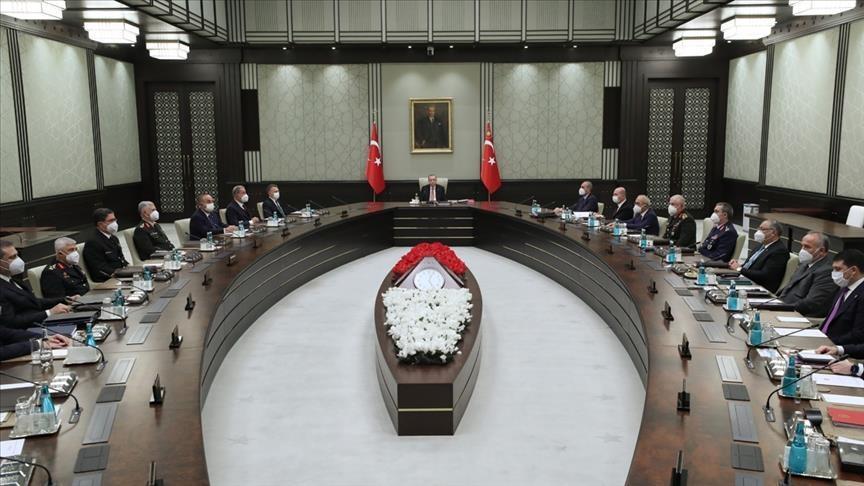
In a three-hour meeting chaired by President Recep Tayyip Erdoğan in the capital Ankara, senior Turkish officials discussed foreign policy, terrorism, and regional developments, said a council statement.
Greek human rights violations against its Turkish minority and irregular migrants were among issues tackled at the meeting, according to the statement following the meeting held in the presidential complex.
On the crisis in the Eastern Mediterranean, it said countries from outside the region should take a neutral position and a common approach protecting mutual rights and benefits.
Turkey, which has the longest continental coastline in the Eastern Mediterranean, has rejected the maritime boundary claims by Greece and the Greek Cypriot administration, stressing that those excessive claims violate the sovereign rights of Turkey and the Turkish Cypriots.
Ankara last year sent several drillships to explore for energy in the Eastern Mediterranean, asserting its rights in the region, as well as those of the Turkish Republic of Northern Cyprus (TRNC).
Turkish leaders have repeatedly stressed that Ankara is in favor of resolving outstanding problems in the region through international law, good neighborly relations, dialogue, and negotiations.
On the issue of Cyprus, the security council underlined the indispensable need for a permanent and fair resolution based on two independent states to be put on the agenda, adding that the present nearly-half-a-century-old approach that ignored the existence of Turkish Cypriots on the island had been fruitless.
National Security Council calls on Greece to abide by int'l law


 Latest news
Latest news
Latest newsBulgaria Asks NATO to Strengthen Its Defences Amid Black Sea Threats: Sofia Fears Growing Risks to Maritime Shipping
16.Oct.2026
Black Sea Shipping Risks Threaten Bulgaria’s 5 Million Tonnes of Wheat Exports
15.Oct.2026
Georgia’s Foreign Funding and Political Ban Laws Draw Criticism from the Venice Commission
15.Oct.2026
Kazakhstan Promotes a Caspian Green Energy Corridor: Astana Seeks New Routes to the European Market
14.Oct.2026
Inflation in Romania Accelerates to 6.61%: Rising Prices Increase Pressure on Households and the Economy
13.Oct.2026
Can Europe Protect the International Criminal Court from Trump’s Sanctions?
13.Oct.2026
Georgia’s Constitutional Court Continues Case on Banning Opposition Parties: Political Pluralism at Stake
12.Oct.2026
Azerbaijan and Iran Step Up Security Contacts Amid Hijab Protests
12.Oct.2026
Personnel Shortages Complicate Ukrainian Forces’ Rotation: Ukraine Faces Long-Term Challenges on the Front Line
11.Oct.2026
Trump Eases Sanctions on Russian Fuel After Talks with Putin: Kyiv Fears Boost to Moscow’s War Revenues
10.Oct.2026
Putin Seeks to Strengthen Russia’s Influence in the Post-Soviet Space Through the CIS
10.Oct.2026
Russia and the South Caucasus: External Pressure, Political Competition and a Crisis of Trust
10.Oct.2026
Peaceful Settlement Between Armenia and Azerbaijan: Moving from Declarations to Implementation
10.Oct.2026
Moldova Ready to Accept as Many Ukrainians as Necessary if Situation Worsens This Winter
09.Oct.2026
Turkmenistan Turns Avaza into a Regional Diplomatic Hub as Caspian, Central Asian and CIS Agendas Converge
08.Oct.2026