
 02 Sep 2026









Pashinyan puts Putin on notice: Armenia is no longer willing to make decisions under pressure from Moscow
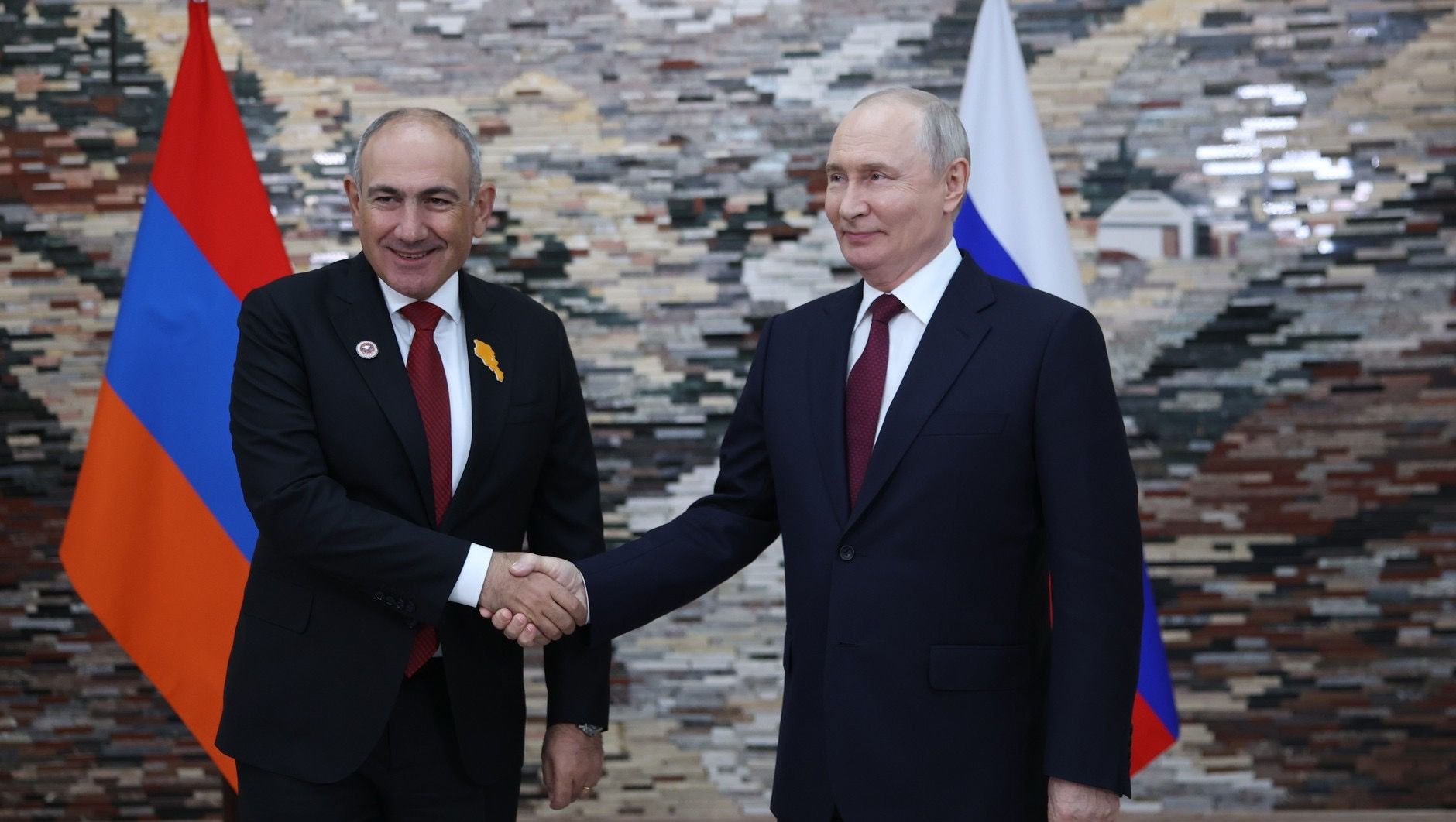
Armenian Prime Minister Nikol Pashinyan demonstrated a notably more independent position in his conversation with Vladimir Putin in Bishkek. Against the backdrop of a dispute over Armenia’s future in the Eurasian Economic Union and its push toward the European Union, the Armenian prime minister effectively rejected any attempt by Moscow to dictate Yerevan’s foreign policy choices.
In Bishkek, Nikol Pashinyan and Vladimir Putin held their first face-to-face meeting following Armenia’s parliamentary elections. The talks, held on the sidelines of the Shanghai Cooperation Organisation summit, quickly moved beyond the traditional bilateral agenda and developed into a relatively tough discussion about the future direction of Armenia’s foreign policy.
One of the central issues was Yerevan’s European course and its compatibility with continued membership in the Eurasian Economic Union (EAEU).
Putin reminded Pashinyan of Armenia’s ambitions to join the European Union (EU) and said Moscow needed to understand Yerevan’s future choice.
The Russian president stressed that Armenia is a sovereign state and has the right to determine its own future. At the same time, he argued that moving toward the EU while remaining a member of the EAEU creates serious contradictions. In effect, Putin urged Yerevan to clarify its future direction sooner rather than later.
Pashinyan’s response was considerably tougher than might have been expected from a traditional Moscow ally. The Armenian prime minister said Yerevan had examined the EAEU’s legal framework and had found no violations of its obligations toward Russia or the union.
Moreover, Pashinyan stressed that Armenia had not notified its partners of any intention to leave the EAEU. According to his position, the adoption of a law launching the process of seeking EU membership does not automatically mean Armenia must leave the Eurasian bloc.
In doing so, Pashinyan effectively rejected Moscow’s interpretation that Armenia’s movement toward the EU necessarily requires withdrawal from the EAEU.
The Armenian prime minister’s reasoning was particularly significant. Pashinyan said Armenia remains interested in preserving and developing relations with Russia, but argued that the regional situation has changed and requires a “fresh look” at bilateral relations.
At the same time, he presented Yerevan’s European course not as an anti-Russian project, but as an effort to ensure that Armenia has genuine alternatives.
According to Pashinyan, the question of making a final choice between different integration paths has not yet matured. Armenia, in his view, should first have real alternatives and only then make a final decision — through a referendum or another procedure provided for by law.
This is where the Bishkek meeting takes on broader geopolitical significance.
For decades, Russia regarded Armenia as one of its key allies in the South Caucasus. Moscow maintained substantial economic, political and military influence in the country. However, the situation has changed significantly.
Following developments in recent years, Yerevan has increasingly sought to diversify its foreign policy and strengthen relations with the EU, the United States, India and other partners.
Against this backdrop, Pashinyan is demonstrating that relations with Moscow no longer necessarily mean automatic alignment with Russia’s political position.
At the same time, the meeting did not end in an open confrontation. Following the talks, Pashinyan described the conversation with Putin as “very good” and said the two sides had agreed to continue the dialogue in Moscow. He also stressed that Armenian-Russian relations remain important for both countries, but need to be reconsidered and reformulated under new conditions.
This indicates that Yerevan is not currently seeking a rupture with Moscow. Rather, Armenia is attempting to move from relations based on its previous system of dependence toward a more pragmatic and multi-vector foreign policy.
The Pashinyan-Putin meeting in Bishkek became a revealing episode in the changing political reality of the South Caucasus. Pashinyan did not announce a break with Russia or call for Armenia’s immediate withdrawal from the EAEU. But he made it clear that the final decision on Armenia’s foreign policy direction will be made in Yerevan, not in Moscow. That is why the Bishkek talks can be viewed as another indication of the gradual shift in the regional balance of influence.
Pashinyan did not break relations with Putin — he did something more important: he publicly drew a line around Russian influence and demonstrated that Armenia intends to determine its own future.


 Latest news
Latest news
Latest newsPashinyan puts Putin on notice: Armenia is no longer willing to make decisions under pressure from Moscow
02.Sep.2026
Russia Turns East: Putin Seeks to Offset the Breakdown of Ties with the West
02.Sep.2026
Romania Faces Political Deadlock: Nicusor Dan Moves to Form a New Government
01.Sep.2026
Pashinyan Meets Aliyev in Bishkek: Armenia and Azerbaijan Prepare for a New Stage in the Peace Process
01.Sep.2026
Ukraine Plans to Present Allies with a New War Strategy and Seek Early EU Funding
31.Aug.2026
The Mecca Pact — Protection or a Trap for Turkiye?
30.Aug.2026
Tigran Khzmalyan: Armenia must make a Decisive Choice in Favor of Europe
30.Aug.2026
Bulgaria to Strengthen Its Black Sea Fleet: Sofia to Receive Seven Minehunter Vessels
29.Aug.2026
Russia Intensifies Strikes on Ukraine’s Infrastructure, Targeting Warehouses and Logistics Hubs
28.Aug.2026
A New Economic Framework for Central Asia and the Caucasus: The Role of Azerbaijan and Uzbekistan
28.Aug.2026
Moscow Warns London: Russia Considers Strikes on British Military Targets
27.Aug.2026
Kazakhstan Launches a New Economic Strategy: GDP Growth, Investment and Pension Reform
27.Aug.2026
CIA Director Visits Moscow: Trump Hopes for Results
26.Aug.2026
Former Ukrainian Defense Minister Warns of Risk of Gradual Defeat in War with Russia
25.Aug.2026
Putin Authorizes Temporary State Management of Critical Infrastructure Vulnerable to Drone Attacks
24.Aug.2026