
 15 Sep 2026









- support for Ukraine;
- strengthening NATO;
- development of the defense industry;
- technological superiority;
- protection of critical infrastructure;
- countering hybrid threats;
- reducing strategic dependencies.
The Riga Conference: Europe Prepares for Long-Term Confrontation with Russia and Reshapes Its Security Architecture
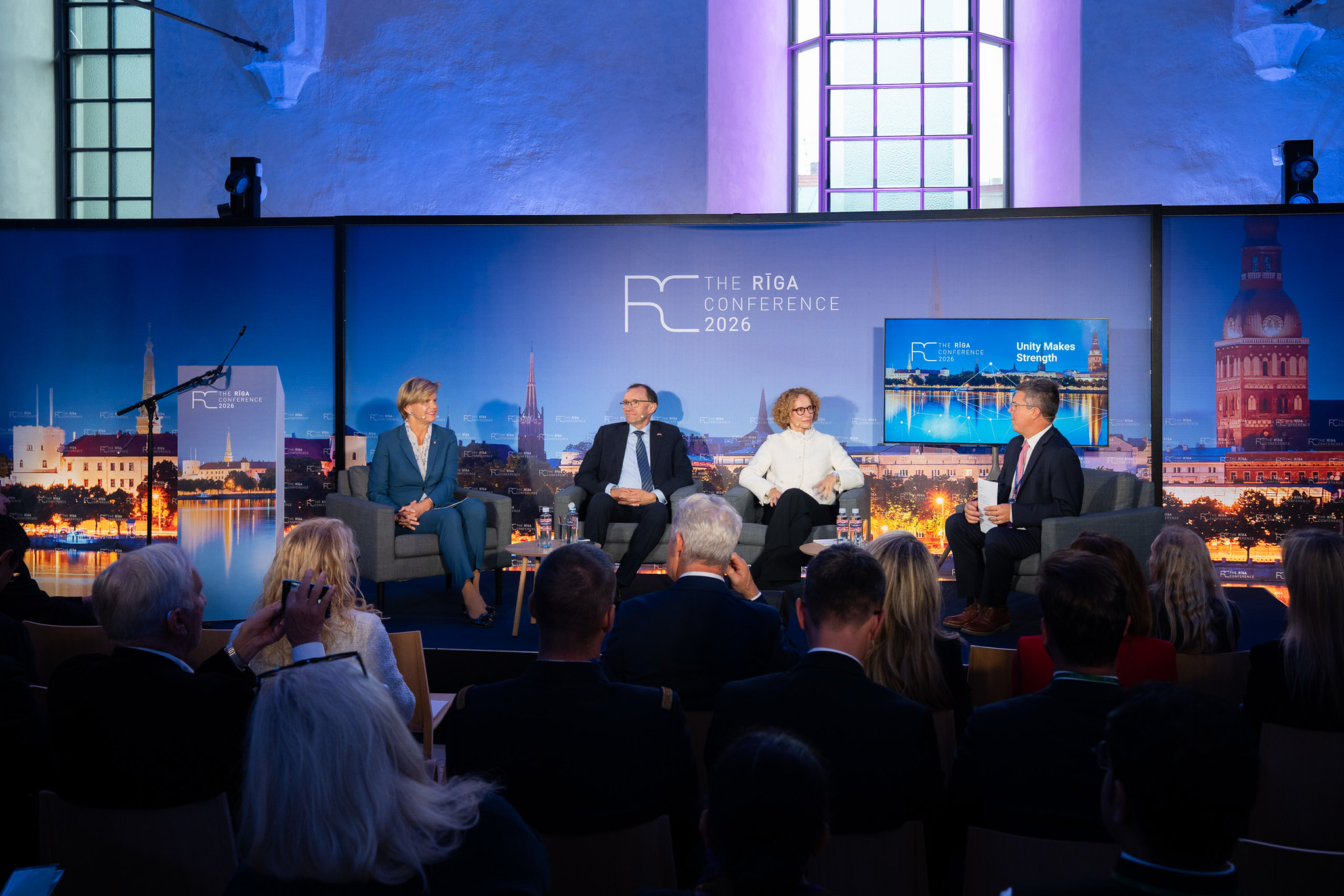
The Riga Conference 2026 demonstrated that the European security debate is gradually moving beyond the immediate issue of the war in Ukraine. Increasingly, the focus is shifting toward a longer-term task: reshaping Europe’s defense system, reducing strategic dependence on external actors, and preparing for prolonged confrontation with Russia.
On September 10–11, the Riga Conference 2026 was held at the National History Museum of Latvia in Riga, bringing together politicians, diplomats, military officials, NATO representatives, experts and business leaders from more than 40 countries. Among the key participants were Latvian President Edgars Rinkēvičs, Foreign Minister Baiba Braže, Defense Minister Rāvis Melnis, NATO Deputy Secretary General Radmila Shekerinska, Chief of Defense of Germany Carsten Breuer, NATO Representative in Ukraine Patrick Turner, and other senior representatives of European and Euro-Atlantic institutions.

The main conclusion of the forum is that European states are increasingly viewing the current conflict not merely as a Ukrainian crisis, but as a structural challenge to the entire European security system.
Europe Prepares for Prolonged Confrontation
One of the central themes of the conference was the need to strengthen Europe’s deterrence capabilities. Latvian Defense Minister Rāvis Melnis stressed the importance of strengthening defense capabilities, investing in technological superiority, reducing strategic dependencies and continuing support for Ukraine.
This reflects a broader shift in European strategic thinking. During the initial stages of the war, the primary question was how to provide Ukraine with the necessary weapons and prevent the conflict from expanding. European states are now increasingly focused on building a sustainable security system for the years ahead.
In effect, this represents a transition from temporary crisis response to the permanent adaptation of Europe’s defense architecture. Latvia, Lithuania, Estonia, Poland and other countries in the region view Russian military and hybrid activity as a long-term factor that cannot be eliminated through diplomatic mechanisms alone.
As a result, strengthening defense capabilities, developing the defense industry, increasing military spending and advancing technological modernization are becoming not temporary measures, but elements of a new state policy.
Ukraine Is Becoming a Source of Military Technology and Battlefield Experience
The experience of Ukraine occupied a separate place in the discussions. European countries are increasingly viewing Ukraine not only as an example of modern warfare, but also as a source of practical solutions for their own armed forces.

Particular importance is being attached to unmanned systems, artificial intelligence, electronic warfare, counter-drone technologies, intelligence systems and the ability to rapidly adapt military technologies directly on the battlefield.
The speed of technological adaptation is becoming one of the key lessons of the war.
In this sense, the war in Ukraine is gradually becoming a testing ground for the development of a new European defense model.
Russia Is Viewed as a Long-Term Source of Instability
An important feature of the conference was the attention devoted to Russia’s internal transformation and its geopolitical consequences. This issue was addressed by Alexander Gabuev, Director of the Carnegie Russia Eurasia Center, and Russian opposition politician Vladimir Milov.
The inclusion of Russia’s transformation in the central conference agenda reflects a broader shift in the European approach. The question is no longer only what the outcome of Russia’s war against Ukraine will be. European states are also seeking to understand what Russia itself will look like after the current period of confrontation, how stable its political system will remain, and whether Moscow will retain the ability to project power beyond its borders.
This is of fundamental importance for NATO’s long-term strategic planning.
Even a potential cessation of active hostilities would not necessarily mean a return to the previous European security model. For Eastern European states, the question remains whether Russia would regard the end of the war as a temporary pause or as the conclusion of a broader cycle of confrontation.
For this reason, European strategic planning is increasingly focused not on one specific scenario for ending the war, but on the ability to respond to a broad range of possible scenarios.
Hybrid Warfare Moves to the Fore
The Riga Conference also demonstrated that the concept of security in Europe has expanded significantly. The forum’s agenda included cognitive warfare, disinformation and cybersecurity. Discussions featured Jānis Sārts, Director of the NATO Strategic Communications Centre of Excellence, and Juhan Lepassaar, Executive Director of the European Union Agency for Cybersecurity (ENISA).

This indicates that European states no longer view the potential Russian threat exclusively through a military lens.
Information operations, cyberattacks, election interference, pressure on critical infrastructure, manipulation of public opinion and the exploitation of economic dependencies are increasingly being treated as components of a broader threat environment.
Future European security will therefore depend not only on the number of tanks, aircraft and missiles, but also on the ability of states to protect their information space, energy infrastructure, transport networks and digital systems.
Economic Resilience Becomes Part of Defense
It is significant that European economic resilience was also among the central themes of the conference. On September 9, ahead of the main event, the Riga Conference Business Forum was held to discuss the impact of geopolitics on business, access to European financing, supply-chain protection, cybersecurity and dual-use technologies.
This reflects an important strategic shift: economic resilience is increasingly being viewed as an element of national security.
If a state depends on a single energy supplier, a critical transport route, foreign technology or an external source of raw materials, such dependence can become a tool of political pressure.
Reducing strategic dependencies is therefore becoming part of Europe’s broader security strategy.
The Black Sea and the South Caucasus
Of particular interest to countries in the region was the fact that the conference’s public events addressed Black Sea security and the connectivity of critical infrastructure. A separate discussion also focused on Latvia–India cooperation amid the changing geopolitical environment.

The European security system is gradually coming to view the Black Sea not as a peripheral region, but as an important strategic link connecting Europe with the Caucasus, Central Asia and the wider Indo-Pacific region.
Armenia, Georgia and Azerbaijan are situated in a space where European interests in transport corridors, energy security, digital infrastructure and regional stability intersect.
In this context, Black Sea security is directly linked to the development of the Middle Corridor, alternative energy routes and trade connections between Europe and Asia.
The Main Signal from Riga
The Riga Conference 2026 effectively demonstrated the emergence of a new European security logic.
Its foundations consist of several interconnected elements:

At the same time, Russia continues to occupy a central place in European strategic planning, but no longer solely as a source of an immediate military threat.
Moscow is increasingly viewed as a factor capable of affecting Europe’s military, energy, information, economic and political security simultaneously.
The key outcome of the Riga Conference is Europe’s gradual shift from a policy of responding to the Russian threat toward building a long-term deterrence system. European states are increasingly less reliant on a rapid return to the previous architecture of relations with Moscow and are investing more in their ability to withstand prolonged geopolitical confrontation independently.
In this context, the war in Ukraine is becoming not only an ongoing conflict, but also a catalyst for a profound restructuring of European security. If the current course continues, Europe could develop a significantly more integrated defense industry, more resilient supply chains, stronger protection of critical infrastructure, and closer integration between military, economic and information security in the coming years.
The European security system is being reshaped with a view to long-term competition and the potential persistence of Russia as one of the main security challenges.
Journalist
MARINE KHARATYAN


 Latest news
Latest news
Latest newsArmenia Energy Diversification: Testing the Limits of Dependence on Russian Gas
15.Sep.2026
Tbilisi Distances Itself from Brussels as Kobakhidze Intensifies Criticism of European Policy
14.Sep.2026
Russia Fuel Crisis Gives the US a New Diplomatic Leverage Tool
14.Sep.2026
Trump Calls on Zelenskyy to Stop Strikes on Russian Oil Infrastructure
13.Sep.2026
Ukraine Expands Pressure on Russia’s Shadow Fleet: Moscow’s Oil Logistics Under Threat
13.Sep.2026
The Riga Conference: Europe Prepares for Long-Term Confrontation with Russia and Reshapes Its Security Architecture
12.Sep.2026
A “Sanctions-Resilient” Route: Modernizing Logistics in Dagestan to Strengthen the North–South Corridor
11.Sep.2026
Black Sea Shield: How the War in Ukraine Forced Romania to Rewrite Its Defense Strategy
11.Sep.2026
Moldova Accelerates EU Integration: Brussels Forced to Increase Resources
10.Sep.2026
Russia Intensifies Strikes on Ukraine After US Talks with Moscow and Kyiv
09.Sep.2026
Georgia Accelerates Middle Corridor Development: Tbilisi Bets on Transit between Asia and Europe
08.Sep.2026
Russia is Losing its Oil Buffer: The War is Beginning to Reshape the Country’s Energy Model
08.Sep.2026
Washington Opens a New Front of Pressure on Ankara: Sanctions on Turkish Bank Test the Limits of US-Turkiye Relations
07.Sep.2026
Iran is losing its main Trump Card: Hormuz is no longer an absolute lever of pressure on the Global Economy
06.Sep.2026
The China Factor in Georgia: Tbilisi Builds a New Geopolitical Pillar
06.Sep.2026