
 27 May 2026









- on the one hand, the authorities seek to demonstrate to the domestic audience the modernization of the armed forces and the state’s ability to ensure the protection of sovereignty;
- on the other hand, official Yerevan aims to avoid creating the impression of revanchism, especially amid the current negotiation process with the Azerbaijani side.
- previously, the symbolism of military parades was built primarily around historical memory and victory;
- today, the central focus lies on technological modernization.
- the demonstration of new weapon systems is aimed at restoring trust in national security institutions. The parade symbolizes not only military modernization but also the state’s ability to maintain institutional resilience and governability amid external and internal challenges;
- the event also contributes to the domestic political legitimization of the current government. Holding the parade during the parliamentary campaign underscores the role of the present administration in initiating armed forces reforms and modernizing the national security system. In this sense, the parade functions as an important instrument of political legitimization.
Military Parade on May 28 in Armenia as an Instrument of Political Communication
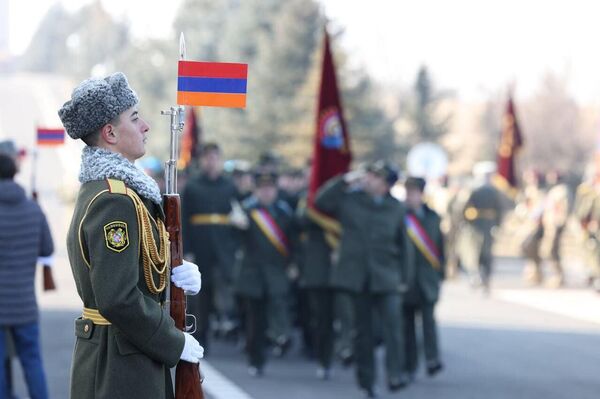
The decision to hold a military parade in Yerevan on May 28, 2026, represents a significant element of the current Armenian government’s political strategy within the framework of the ongoing election campaign in Armenia. Armenian Prime Minister Nikol Pashinyan noted that the idea of organizing the parade emerged following an initiative launched in November 2025, when citizens were invited to form groups of 50 people and apply for access to military equipment exhibitions under conditions of non-disclosure. According to him, public interest proved so high that the authorities deemed it appropriate to organize an open parade for the broader public.
Balancing the “Peace Agenda” and the Demonstration of Defensive Capabilities
The key objective of the upcoming parade is to simultaneously address two contradictory strategic tasks: demonstrating the country’s defense capabilities while preserving the officially adopted “peace agenda”.
Against this backdrop, Nikol Pashinyan described the parade as a “very delicate matter”, emphasizing the need for prior consultations with international and regional partners. The goal, according to him, is to prevent the event from being interpreted as a sign of a shift in Yerevan’s strategic course. He stated that the weapons acquired in recent years would be presented with an emphasis on peace so that “neighbors would not perceive this as a demonstration of aggression”.
Such caution is обусловed by Armenia’s current position within the regional security system:
In official rhetoric, the parade is presented exclusively as a demonstration of defensive capabilities. According to Pashinyan, Armenia’s armed forces must serve solely the purpose of protecting the country’s sovereign territory and should not pursue any objectives beyond the republic’s internationally recognized borders.
Military Modernization, New Weapons, and International Cooperation
Published rehearsal videos already showcase Armenian-made reconnaissance drone systems. The authorities emphasize that these are weapons acquired and developed in recent years. The footage notably includes the new Armenian loitering munition drone Dev-3 mounted on a military pickup truck, as well as a self-propelled artillery system. Prime Minister Pashinyan separately noted that over the past three years, during which approximately 170 billion drams in orders were placed in the military-industrial sector, dozens of enterprises and factories producing defense-related products had been established.
Particular emphasis is placed on domestically produced military equipment. This focus is intended to highlight Armenia’s technological sovereignty and achievements in developing its defense industry. It forms part of a broader strategy aimed at shaping the image of a country capable of ensuring its own security through internal resources. This emphasis reflects a substantial shift in political rhetoric:
Armenian Minister of High-Tech Industry Mkhitar Hayrapetyan discussed the types of weaponry that will be displayed on May 28 in Yerevan during the parade marking the First Republic of Armenia. According to him, the parade will feature domestically produced military equipment currently in the arsenal of the Armenian Armed Forces — ranging from drones to radars, communication systems, and other types of military technology. Nevertheless, the minister avoided providing detailed information in order to preserve public intrigue surrounding the event.
At the same time, considering Prime Minister Pashinyan’s statement that weapons acquired after 2022 would be demonstrated at the parade, it is possible to make preliminary assumptions regarding which systems may be showcased.
After 2022, Armenia significantly diversified its arms procurement sources, shifting emphasis toward France, India, and other countries. Acquired systems include artillery platforms, air-defense systems, armored personnel carriers, multiple-launch rocket systems, and other categories of weaponry. Therefore, it is reasonable to assume that the parade will feature systems obtained through military-technical cooperation with India and France.
What Weapons Were Acquired After 2022?
In November 2022, Armenian and Indian media reported that Armenia would purchase Konkurs-M anti-tank guided missiles — a significantly modernized version of the AT-5 Spandrel system designed to destroy armored vehicles protected by reactive armor, fortified engineering structures, naval targets, and low-flying combat helicopters. Armenia also became the first foreign buyer of India’s Pinaka multiple-launch rocket system, capable of firing 12 rockets within 44 seconds. The Pinaka rocket has a range of 60 kilometers, a length of 4,950 mm, and a caliber of 214 mm. The acquisition of the Pinaka MLRS carries particular significance because it strengthens not only defensive capabilities but also long-range strike potential.
On October 23, 2023, French Defense Minister Sébastien Lecornu announced that the defense ministers of France and Armenia had signed an agreement for the sale of three GM 200 radars manufactured by Thales, along with a memorandum of understanding concerning future deliveries of French Mistral short-range air-defense systems. He stated that France was helping Armenia improve its air-defense capabilities through the sale of the GM 200 radars. Lecornu also noted that France would assist Armenia in training its ground defense forces and support efforts to reform and modernize the Armenian Armed Forces.
In November 2023, Armenia signed an agreement to procure the Zen anti-drone system developed in India. The contract was reportedly worth $41.5 million. Developed by Zen Technologies, the system detects and classifies UAVs, identifies passive reconnaissance activities conducted by drones, and neutralizes threats by disrupting drone communication systems. Zen Technologies also announced that during a board meeting held on October 28, 2023, the opening of a branch office in Armenia had been approved. Additionally, in November 2023, two dozen Bastion light multi-purpose armored vehicles manufactured in France arrived in Armenia.
In 2024, the platform Indian Defense Research Wing reported that India would deliver the first domestically produced Akash-1S air-defense missile systems to Armenia by the end of the year. The Akash-1S system combines active target acquisition and guidance technologies, providing reliable protection against aerial threats such as fighter aircraft, guided missiles, and unmanned aerial vehicles. In November 2024, Armenia also initiated the procurement process for an additional 84 ATAGS artillery systems.
On May 12, 2026, the first French-made 155-mm CAESAR wheeled self-propelled artillery systems were delivered to Armenia. The contract for the supply of 36 self-propelled artillery units based on the Sherpa 5 6x6 wheeled truck chassis had originally been signed in June 2024.
In this context, the international dimension of the parade is particularly important. The event effectively presents Armenia’s new architecture of military-political relations, with special emphasis placed on cooperation with France.
Commenting on the upcoming event, Nikol Pashinyan stated: “On May 28, you will see what French President Emmanuel Macron has done for Armenia”.
This rhetoric demonstrates the gradual diversification of Armenia’s military-political orientation. Whereas Armenia’s defense model was previously associated almost exclusively with cooperation with Russia, the parade now points to the emergence of new military-political partners such as France and India. Consequently, the parade also serves an important foreign-policy function: demonstrating the transition from a model of one-sided dependence toward a more multi-vector system of national security provision.
Public Perception and Political Polarization
Public reaction to the upcoming parade remains mixed and reflects the high level of political polarization within Armenian society. For supporters of the current government, the parade symbolizes the restoration of statehood and serves as evidence of successful military modernization. Media outlets supportive of the authorities actively employ rhetoric centered on a “new army”, “new quality”, and a “new security logic”, emphasizing not only the technical aspects of the parade but also its emotional and symbolic significance.
Within opposition discourse, however, the parade is interpreted as part of the government’s election strategy. Some media outlets criticize the decision to hold the parade, citing public distrust and arguing that such an event is inappropriate amid territorial concessions and ongoing security threats.
According to Ishkhan Saghatelyan, a representative of the Supreme Body of the Armenian Revolutionary Federation Dashnaktsutyun and a member of parliament from the “Armenia” bloc, the parade is “exclusively an election-related military parade aimed at the domestic audience rather than external actors”.
Other differences are also evident in public perception. For example, older generations may feel stronger emotional involvement, perceiving the parade through the prism of historical events and associating it with the protection of territorial integrity. Younger citizens, by contrast, are more likely to evaluate the parade from the standpoint of technological achievements and prospects for military development, often with less emotional attachment.
The May 28 military parade in Yerevan can therefore be viewed as a political communication instrument aimed primarily at the domestic audience rather than external actors. According to a number of experts and opposition figures, the event forms part of the current government’s strategy to strengthen its political position ahead of parliamentary elections.
During a briefing on March 26, Prime Minister Nikol Pashinyan stated that May 28 would represent “not so much a military parade as a report to the citizens of Armenia”. This rhetorical strategy reflects the authorities’ attempt to integrate the demonstration of military power into a broader political narrative concerning the transformation of Armenian statehood against the backdrop of official rhetoric centered on the peace agenda.
Within this framework, the parade fulfills several interconnected objectives:
Thus, the parade becomes part of a broader political communication strategy. The emphasis shifts away from the quantitative size of the armed forces toward showcasing new weapon systems and innovative technological solutions. The emotional effect of the parade is also significant. It generates feelings of pride among citizens, creating a positive emotional background that may influence voter attitudes toward the current authorities.
Conclusion: Who Is the Parade’s Message Intended For?
The message of the parade is aimed primarily at the domestic audience rather than external actors. The emphasis on domestically produced weaponry is particularly important for the government’s internal image. Moreover, despite the diversification of arms suppliers, official rhetoric contains no direct challenge toward external actors. On the contrary, the authorities emphasize the peaceful nature of the event and conduct consultations with regional and international partners in order to avoid misinterpretation of their intentions.
Finally, the internal orientation of the parade is reflected in the political polarization within Armenian society itself. Reactions to the event remain divided: supporters of the government view it as a symbol of restored statehood, while the opposition perceives it as part of the ruling authorities’ election strategy. This division confirms that the event is designed to shape perceptions inside the country rather than exert influence abroad.
Undoubtedly, the parade also has a foreign-policy dimension, as it demonstrates Armenia’s new military-political partnerships, including cooperation with France. However, its primary purpose lies in addressing domestic political objectives within the context of the election campaign. This is clearly reflected both in official rhetoric and in the broader context surrounding the organization of the event.
Analyst,
Mariana Shafrazyan


 Latest news
Latest news
Latest newsMilitary Parade as a Manifesto: What Armenia Wants to Tell the World on May 28
25.May.2026
The War in Ukraine: The Russian Army is Already Running Out of Steam
25.May.2026
Railway Breakthrough: Armenia Integrates into the Akhalkalaki–Kars Route
24.May.2026
Tbilisi on the Eve of May 26: Independence Day Turns Into a Day of Political Struggle
24.May.2026
The US and Iran Continue Negotiations on a Possible Agreement and Extension of the Ceasefire
23.May.2026
The United States Suspends Participation in Ukraine Negotiations
22.May.2026
Azerbaijan and Georgia Strengthen Strategic Partnership with New Package of Agreements Signed
21.May.2026
Russia and China Strengthen Coordination on Key International Issues
20.May.2026
Beijing’s Hidden Role: Chinese Military Training for Russian Forces Revealed
19.May.2026
Pakistan Delivers Iran’s Revised Proposal to the US to End the War
18.May.2026