
 27 May 2026









- Bastion armored personnel carriers — first deliveries arrived in 2024;
- Radar surveillance and reconnaissance systems;
- Possibly CAESAR self-propelled artillery systems, as negotiations regarding their acquisition were previously reported.
- Pinaka multiple-launch rocket systems (214 mm), capable of striking targets up to 75 km away;
- ATAGS 155 mm artillery howitzers — the first batch of six units was delivered in August 2023, while the total order amounts to 90 guns;
- Akash-1S air defense missile systems — ordered in 2022, with deliveries expected by the end of 2024;
- Konkurs anti-tank missile systems and ZADS anti-drone systems.
- Drones of various classes developed by Davaro and other Armenian manufacturers — reconnaissance UAVs, strike drones, and loitering munitions;
- Locally produced ammunition and small arms.
Military Parade as a Manifesto: What Armenia Wants to Tell the World on May 28
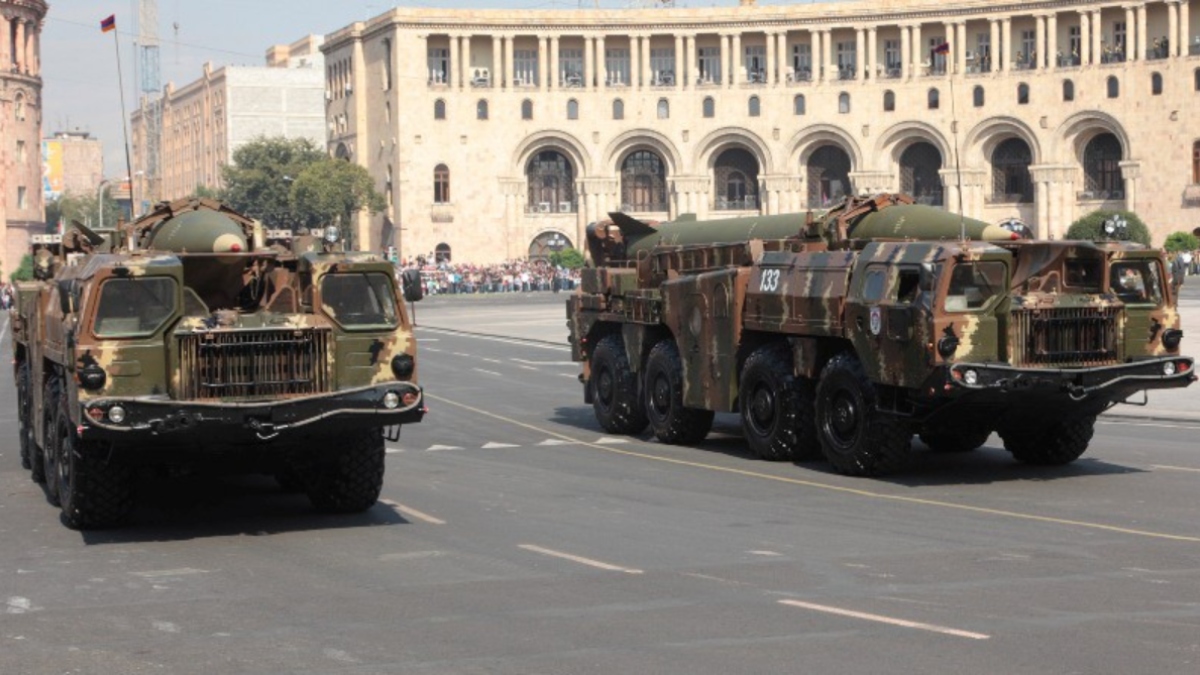
On May 28, 2026, the first military parade in ten years will take place on Republic Square in Yerevan. The last one was held on September 21, 2016, before the “Velvet Revolution” that brought Nikol Pashinyan to power. Significantly, this year’s event is dedicated not to the traditional Independence Day on September 21, but to the Day of the First Republic on May 28 — a choice that carries a clear political message in itself: an appeal to the original Armenian statehood of 1918 rather than to the Soviet legacy.
From the very beginning, Pashinyan deliberately avoided using the word “parade”. Speaking at a briefing after a government meeting on March 26, he described the upcoming event as “a report to the citizens of Armenia”, adding: “A military parade is a very delicate phenomenon that may create the impression of abandoning the peace agenda. Therefore, we continue working with international partners, including countries in the region, so they do not perceive this as a rejection of the peace agenda”. Notably, the decision to make the display public emerged because of overwhelming demand: back in November 2025, Pashinyan invited citizens to inspect the new military equipment through a pre-registration system, but the number of applications became so large that the plan was declared “logistically impossible.” Nevertheless, rehearsal footage published on his Telegram channel leaves no doubt: this is indeed a full-scale military parade with armored vehicles moving through the capital’s central square. “Neighbors should not perceive this as a demonstration of aggression”, he added. This semantic balancing act is revealing. Armenia wants to demonstrate strength without appearing aggressive.
What Will Be Displayed: The Arsenal of a New Era
According to Pashinyan, the parade will feature all weapons systems purchased or produced after 2022. At the same time, he added: “Everything that needs to be concealed will remain concealed”. This means the public will only see the “presentation layer” of Armenia’s military modernization, while the most sensitive systems will remain out of sight. Publishing footage of the rehearsals on his Telegram channel in May 2026, the prime minister specifically emphasized that the drones shown were produced in Armenia, thereby highlighting the development of the national defense industry. Defense Minister Suren Papikyan, in turn, drew a clear line: “Armenia is not going to enter an arms race with anyone”, while also stressing that military procurement and modernization would continue.
Based on open-source data regarding Armenia’s defense purchases between 2022 and 2026, the following systems are highly likely to appear in the parade.
From France — under the military cooperation agreement signed in October 2023:
From India — Yerevan’s new key supplier:
Domestically produced systems:
Soviet- and Russian-made equipment that still forms the backbone of Armenia’s military inventory — including T-72 tanks, infantry fighting vehicles, and Soviet-era artillery — will likely also be present. However, it is the Western and Indian systems that will become the symbolic centerpiece of the display.
The Scale of Rearmament: Numbers That Change the Picture
To understand the significance of the upcoming parade, one must grasp the scale of Armenia’s defense transformation in recent years.
According to Defense Minister Suren Papikyan, Armenia’s spending on weapons procurement and military equipment between 2022 and 2025 exceeded the equivalent spending of the previous twenty years by a factor of 5.4. Speaking in parliament in March 2026, he was explicit: “From 1998 to 2018, during the two decades under two presidents, defense spending, including arms procurement and military equipment, was 5.4 times lower than in the period from 2022 to 2025”. While Armenia’s defense budget stood at around $645 million in 2018, by 2025 it had reached $1.74 billion — nearly a threefold increase in seven years. Military expenditures accounted for 6% of GDP in 2025, one of the highest figures in the world.
The geopolitical shift in procurement is equally striking. According to SIPRI, Russia accounted for up to 94% of Armenia’s arms imports between 2011 and 2020. By 2024, that share had collapsed to just 10%. India and France became the main suppliers: defense contracts worth more than $1.5 billion were signed with New Delhi in 2022–2023 alone, while agreements with Paris totaled around $250 million. Simultaneously, Armenia has intensified military dialogue with the United States, Greece, Cyprus, South Korea, and China.
The catalyst for this shift was the catastrophe of 2020: Armenia’s defeat in the 44-day war with Azerbaijan exposed the country’s critical dependence on a single supplier — Russia — which failed to promptly deliver approximately $400 million worth of contracted weapons.
Armenia’s Defense Industry: The Emergence of Sovereignty
A separate and politically significant storyline is the demonstration of domestically produced weapons. Pashinyan explicitly stated that the parade would showcase “weapons that we ourselves produced”.
After 2020, Armenia sharply accelerated efforts to build its own defense industry. At the ArmHighTech-2022 exhibition, several Armenian companies unveiled drones of various classes — reconnaissance UAVs, strike drones, and loitering munitions designed “from scratch” using local production capabilities. Davaro and other startups reported strong interest from the Ministry of Defense in their products.
The development of domestic military production is not merely a military necessity but part of a broader strategy: reducing the political dependence that nearly cost the country its sovereignty in 2020.
Domestic Politics: The Parade as an Electoral Argument
It is impossible to ignore the fact that the May 28 parade will take place less than two weeks before the parliamentary elections scheduled for June 7, 2026. This gives the event a distinctly electoral dimension.
The ruling Civil Contract party has built its campaign around two key messages: Armenia under Pashinyan secured peace, and Armenia under Pashinyan rearmed itself. The parade is intended to visualize the second claim — to show citizens the tangible results of a policy that the opposition calls capitulationist.
The opposition rejects this narrative. Former President Robert Kocharyan, leader of the Armenia bloc, told voters in Ijevan: “The lesson of the Su-30SM fighter jets was apparently not enough — the Armenian authorities are once again buying weapons they will not be able to use”. According to him, by organizing the parade, the authorities are “trying to throw dust in people’s eyes”. Kocharyan proposes a different security formula: “a modern combat-ready army, a strong leader, and a powerful ally in the form of Russia”.
Former Defense Minister Seyran Ohanyan, also part of the Armenia bloc, appeals to a different sentiment: “The Armenian people can straighten their backs and move forward”, portraying the opposition as a force capable of restoring the country’s sense of agency.
Pashinyan himself, campaigning in the regions, points to the “new army” as proof of the viability of his political course: “People! Emigration has stopped, immigration to Armenia has begun — that is the future”.
According to a poll conducted by the International Republican Institute (IRI) in February 2026, 72% of Armenians support possible EU membership, while 51% would vote in favor if a referendum were held “next Sunday”. The May 28 parade is both a reflection of this public demand and an attempt to reinforce it.
Neighbors’ Reactions: Anxiety in Baku, Tension with Moscow
Azerbaijan has not officially reacted to the parade announcement with harsh statements, but its silence does not mean indifference. Baku already views Armenia’s military procurement — especially French weapons — with deep suspicion. President Aliyev has accused the European Parliament of “sabotaging the peace process” and repeatedly made territorial statements bordering on threats. In this context, the public display of Yerevan’s new arsenal will inevitably harden Baku’s rhetoric.
Russia has reacted with growing irritation to everything taking place in Armenia. State Duma deputy Konstantin Zatulin “warned” that if the current Armenian government is reelected, “Russian-Armenian relations will head toward rupture”. The Russian Foreign Ministry openly stated that “Armenia’s European path may lead to changes in relations with Russia”. A separate diplomatic incident emerged during the May summit of the European Political Community in Yerevan, where Ukrainian President Volodymyr Zelenskyy said that “Ukrainian drones may visit” Moscow’s May 9 parade. Armenia’s ambassador to Russia was subsequently summoned to the Russian Foreign Ministry. Armenian Security Council Secretary Armen Grigoryan responded cautiously, saying Armenia “cannot bear responsibility for the rhetoric of other participants in the forum”. What irritates Moscow is not merely the May 28 parade itself, but the fact that much of the equipment displayed there is of Western and Indian origin — a material embodiment of Yerevan’s geopolitical drift. Armenia, meanwhile, continues moving closer to the EU: in May 2026, the first-ever Armenia–EU summit took place, and French President Emmanuel Macron called for helping Armenia secure its borders “without the participation of Russian servicemen”.
Turkey has taken its traditional position — de facto supporting Azerbaijan while formally normalizing relations with Armenia. In May 2026, it became known that the two sides had completed preparations for launching direct trade. This balancing act does not eliminate Turkish concerns regarding Armenia’s military modernization.
Goals and Logic: Why Does Armenia Need This Parade?
The parade serves several interconnected objectives.
First, it is a signal of deterrence. Since 2020, Armenia has found itself in a vulnerable position: the loss of Karabakh and unresolved border delimitation issues with Azerbaijan. Under these circumstances, the display of new weapons systems sends a message to potential adversaries: the price of a new conflict has increased.
Second, it is about legitimizing expenditures. The unprecedented growth of the military budget requires public approval. Showing citizens “what their money paid for” is politically necessary, especially ahead of elections.
Third, it is a manifesto of geopolitical choice. Indian rocket systems and French armored vehicles on Yerevan’s main square are not merely military hardware. They are a visible embodiment of Armenia’s strategy of diversifying away from Russia and moving closer to the West. The parade is addressed simultaneously to Armenian citizens and to the outside world.
Fourth, it is a demonstration of institutional growth and psychological recovery. The defeat of 2020 and the loss of Karabakh in 2023 inflicted deep psychological trauma on Armenian society. The image of a renewed and reequipped army is an attempt to overcome the sense of helplessness. Pashinyan has repeatedly stressed that the parade is, above all, a “report”: proof that the state is capable of planning, financing, and implementing a large-scale defense modernization program. It is a message directed both inward and outward.
Conclusion: A Parade at a Crossroads
On May 28, 2026, Armenia will attempt to achieve multiple goals with a single gesture: to report to its citizens, convince allies of its viability, warn adversaries, and mobilize voters. It is a risky and multilayered maneuver.
Critics argue that no parade can eliminate the threat of another conflict, while the demonstration of new weapons may accelerate the regional arms race in a region where Azerbaijan still retains military superiority.
And yet there is something greater in the May 28 event than mere pre-election spectacle. It is evidence that a small country, having endured a catastrophic defeat, has decided not to accept the role of a victim — but to attempt to become the author of its own security.
Journalist
Marine Kharatyan


 Latest news
Latest news
Latest newsMilitary Parade as a Manifesto: What Armenia Wants to Tell the World on May 28
25.May.2026
The War in Ukraine: The Russian Army is Already Running Out of Steam
25.May.2026
Railway Breakthrough: Armenia Integrates into the Akhalkalaki–Kars Route
24.May.2026
Tbilisi on the Eve of May 26: Independence Day Turns Into a Day of Political Struggle
24.May.2026
The US and Iran Continue Negotiations on a Possible Agreement and Extension of the Ceasefire
23.May.2026
The United States Suspends Participation in Ukraine Negotiations
22.May.2026
Azerbaijan and Georgia Strengthen Strategic Partnership with New Package of Agreements Signed
21.May.2026
Russia and China Strengthen Coordination on Key International Issues
20.May.2026
Beijing’s Hidden Role: Chinese Military Training for Russian Forces Revealed
19.May.2026
Pakistan Delivers Iran’s Revised Proposal to the US to End the War
18.May.2026