
 27 May 2026









War or Peace: The Electoral Discourse Around the Peace Treaty with Azerbaijan
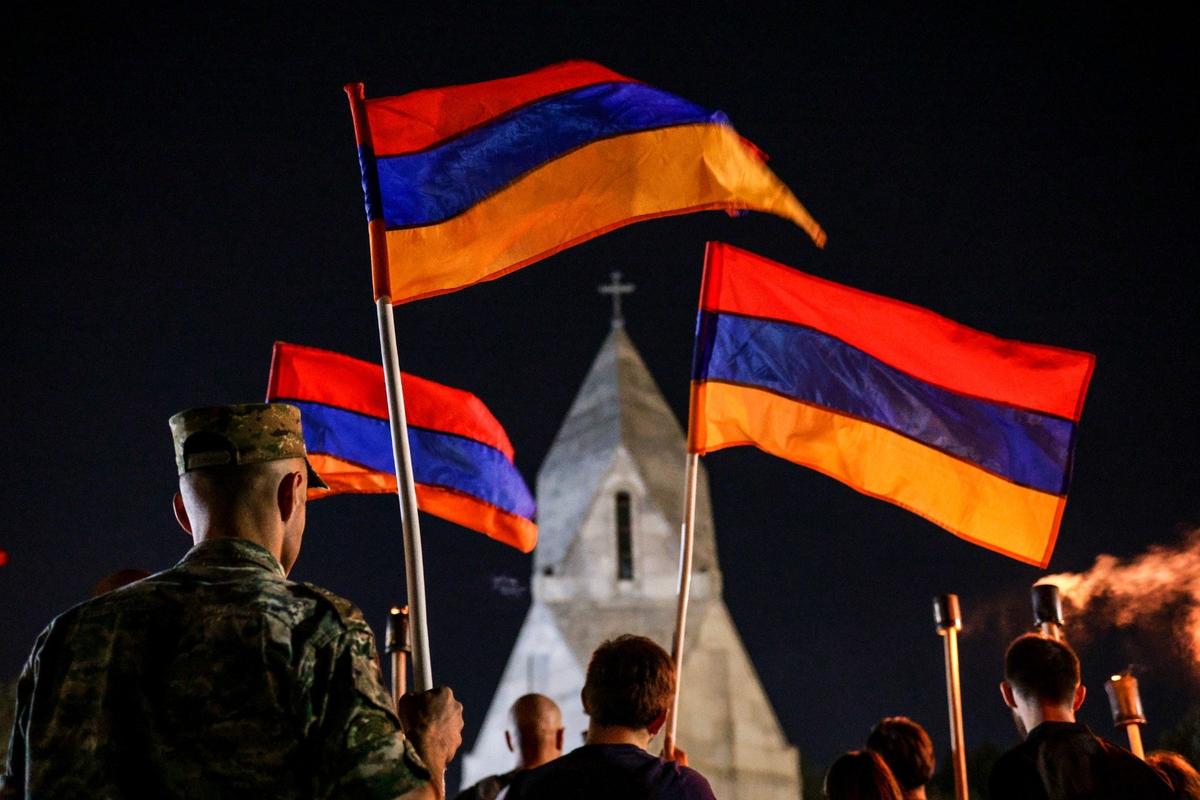
Negotiations between Armenia and Azerbaijan
are increasingly becoming not only a foreign policy process but also an arena
of intense domestic political competition. While the government of Nikol
Pashinyan promotes a “realistic peace” agenda and has effectively launched its
electoral campaign under the “peace” narrative, the opposition is constructing
a systematic counter-discourse in which the key term is not “peace” but
“imposed capitulation”, allegedly lacking real security guarantees.
Already
19 political forces have submitted documents to the Central Electoral
Commission of Armenia, and their approaches to the peace process can be broadly
divided into several categories. The ruling Civil Contract party and
pro-Western forces support the rapid signing of a peace agreement, the opening
of regional transport links, and normalization of relations with Azerbaijan.
Opposition forces such as the pro-Russian “Hayastan” alliance and “I Have
Honor” insist on a tougher line: prioritizing security, rejecting unilateral
concessions, and ensuring binding guarantees for Armenians, including
international monitoring mechanisms.
A
number of parties and movements emphasize an international legal track — continuing
cases in international courts, strengthening the role of external actors, and
applying diplomatic pressure on Azerbaijan. There are also political forces
advocating a more independent approach, cautious toward external mediation and
focused on internal consolidation.
Additional
tension was introduced by Justice
Minister Srbuhi Galyan’s statement confirming that the draft of a new
Constitution is already ready. This effectively moved constitutional reform
from an abstract agenda into a practical phase with direct implications for negotiations
with Baku. At the same time, the government has stated that a constitutional
referendum is not planned this year.
 Srbui Galyan: The new Constitution of Armenia is legally ready
Azerbaijan’s
demand to amend the Armenian Constitution remains one of the main obstacles to
a peace treaty. This includes the possible removal of references to the
Declaration of Independence — a matter formally described in Yerevan as
internal. However, in practice, the Constitution has already become part of the
negotiation process. Prime Minister Nikol Pashinyan has effectively acknowledged
the possibility of discussing amendments, describing the previous formulation
as a “logic of conflict”.
Thus,
the peace treaty is no longer purely a diplomatic document — it is becoming an
element of state transformation. The government’s argument is based on a strict
logic: the alternative to peace is another war. Pashinyan has explicitly stated
that “continuing the previous logic means a new escalation”. In this paradigm,
compromise is seen as inevitable, the Constitution as an adaptation tool, and peace
as a mechanism for stabilization.
The
government promotes a pragmatic approach: the peace treaty is viewed as an
instrument for security and economic development. Pashinyan’s position across
various speeches reduces to the idea that “peace is a long-term security
guarantee”, even if it requires difficult compromises.
Opposition
forces offer the opposite interpretation. In this discourse, peace is seen not
as security but as dependence and loss of sovereignty. The pro-Russian
opposition leader and head of the “Hayastan” bloc, former President Robert
Kocharyan, emphasizes a key point — guarantees: “Peace cannot depend on the
goodwill of one person”. He insists that a sustainable agreement is only
possible with international guarantors and describes the current process as
“peace based on a gentleman’s agreement”.
In
effect, the opposition shifts the debate to a different plane: not “whether to
sign”, but “what kind of peace is being signed”. A separate line is promoted by
Russian billionaire Samvel Karapetyan, who advocates the concept of “strong
peace”: “Peace is not requested — it is maintained by strength”. His approach
is based on three pillars: a strong army, pragmatic diplomacy, and economic
independence.
 Samvel Karapetyan – Candidate for the Position of Prime Minister of
Armenia
Samvel Karapetyan – Candidate for the Position of Prime Minister of
Armenia
Criticism
of the peace agenda extends beyond traditional opposition. The “Hayakve”
movement actively promotes the idea of protecting the “national agenda” and
opposes constitutional changes that could affect the Declaration of
Independence. Their rhetoric focuses on preserving identity, rejecting “historical
revision”, and mobilizing society against concessions.
Differences
in rhetoric are deepening polarization. The government speaks in terms of
“borders”, “threats”, “institutions”, and “reforms”, while the opposition uses
the language of “loss” and “national trauma”. This gap creates two parallel
informational realities in which compromise becomes increasingly difficult.
Escalation Rhetoric: “Peace or a New War”
During
the pre-election period, political discourse around the peace treaty
increasingly takes the form of stark warnings. The Prime Minister directly
links rejection of the current negotiation path with the risk of a new war.
According to him, revising the peace agenda or the coming to power of forces
opposing the agreement could lead to escalation comparable to the events of
September 2022: “If we abandon this logic of peace or try to revise it, it may
mean a new war, a new ‘September’”.
Thus,
the government frames a clear dilemma: a peace treaty or the risk of renewed
military escalation. Pashinyan has also stated that political forces led by
Robert Kocharyan, Samvel Karapetyan, and Gagik Tsarukyan are effectively moving
toward revising the peace agenda, which, in his words, opens “the door to war”.
The
opposition, in turn, views such rhetoric as pressure on society. Its
representatives accuse the government of using fear of war as a tool to
legitimize concessions, arguing that this framing replaces substantive
discussion of the treaty’s conditions and creates an artificial “peace or war”
dichotomy.
Thus,
the possibility of a new war becomes not only a security factor but also an
instrument of internal political struggle.
Expert Assessments
Pro-Western
forces in Armenia generally support the government’s peace agenda.
Political analyst Davit Stepanyan argues against Robert Kocharyan’s position: “In today’s world, there is no guarantor of peace or security”. He questions whether Russia — the guarantor implied by the opposition — can or is willing to fulfill such a role.

Political analyst Davit Stepanyan
Stepanyan
does not rule out the possibility of a peace treaty before the elections but
considers it unlikely due to regional instability, including the uncertain
outcome of the Iranian crisis.
He
also agrees with Pashinyan’s argument that the return of pro-Russian forces
could increase the risk of escalation, noting that Moscow is not interested in
peace between Armenia and Azerbaijan, as it uses the conflict as a tool of
influence.
At the
same time, political analyst Hrant Mikaelian offers a different assessment. He
believes that any peace agreement would be largely symbolic and would not lead
to real stability. In his view, only two scenarios are possible: “no peace, no
war” or a renewed war.

Political analyst Hrant Mikaelyan
According to Mikaelian, Azerbaijan’s statements about peace are tactical, aimed at gaining concessions from the West. He argues that Armenia must focus on deterrence policy.
Geopolitics: Rising US Role and Shifting
Russian Influence
The
preliminary agreement signed in August 2025 under the mediation of Donald Trump
marked a significant turning point. The sides agreed on several provisions,
including the development of a transport corridor connecting Azerbaijan to
Nakhchivan via Armenian territory. This project strengthens the role of the
United States while reducing Russia’s influence in the region.
However,
the agreement remains a framework document requiring further political
settlement. Washington is interested in accelerating the process as a tool for
expanding its regional influence, but its leverage over Baku remains limited,
especially amid tensions involving Iran.
At the
same time, the European Union is increasing its engagement. Armenia is
deepening cooperation with the EU, including in security and hybrid threat
prevention. However, the EU is not yet perceived as a full security guarantor,
and its role remains primarily political and institutional.
International Court Cases: Pressure and
Counter-Pressure
When
Armenia initiates cases against Azerbaijan in international courts, Baku
typically responds with counterclaims. This creates a bilateral legal process
in which both sides use judicial mechanisms as tools of pressure and
legitimacy.
While
such proceedings establish a legal framework and attract international
attention, they also reinforce confrontation and mistrust, often complicating
rather than accelerating the peace process.
Public Reaction and the Core Question
Even
after the 2025 agreement, public opinion in Armenia remains divided between
cautious optimism and deep skepticism. The peace process has become not only a
diplomatic issue but also a subject of interpretation: for some, it represents
opportunity; for others, risk.
The
peace treaty has effectively become a tool of electoral competition, a marker
of geopolitical orientation, and one of the main drivers of political
polarization.
The
key question in the coming months is whether the peace treaty will become part
of the electoral campaign or be signed after the formation of a new government.
The answer will determine whether the South Caucasus moves toward sustainable
peace or remains in a state of prolonged uncertainty.
Journalist,
Marine Kharatyan


 Latest news
Latest news
Latest newsMilitary Parade as a Manifesto: What Armenia Wants to Tell the World on May 28
25.May.2026
The War in Ukraine: The Russian Army is Already Running Out of Steam
25.May.2026
Railway Breakthrough: Armenia Integrates into the Akhalkalaki–Kars Route
24.May.2026
Tbilisi on the Eve of May 26: Independence Day Turns Into a Day of Political Struggle
24.May.2026
The US and Iran Continue Negotiations on a Possible Agreement and Extension of the Ceasefire
23.May.2026
The United States Suspends Participation in Ukraine Negotiations
22.May.2026
Azerbaijan and Georgia Strengthen Strategic Partnership with New Package of Agreements Signed
21.May.2026
Russia and China Strengthen Coordination on Key International Issues
20.May.2026
Beijing’s Hidden Role: Chinese Military Training for Russian Forces Revealed
19.May.2026
Pakistan Delivers Iran’s Revised Proposal to the US to End the War
18.May.2026