
 27 May 2026









Etchmiadzin at the Epicenter of Political Processes in Armenia
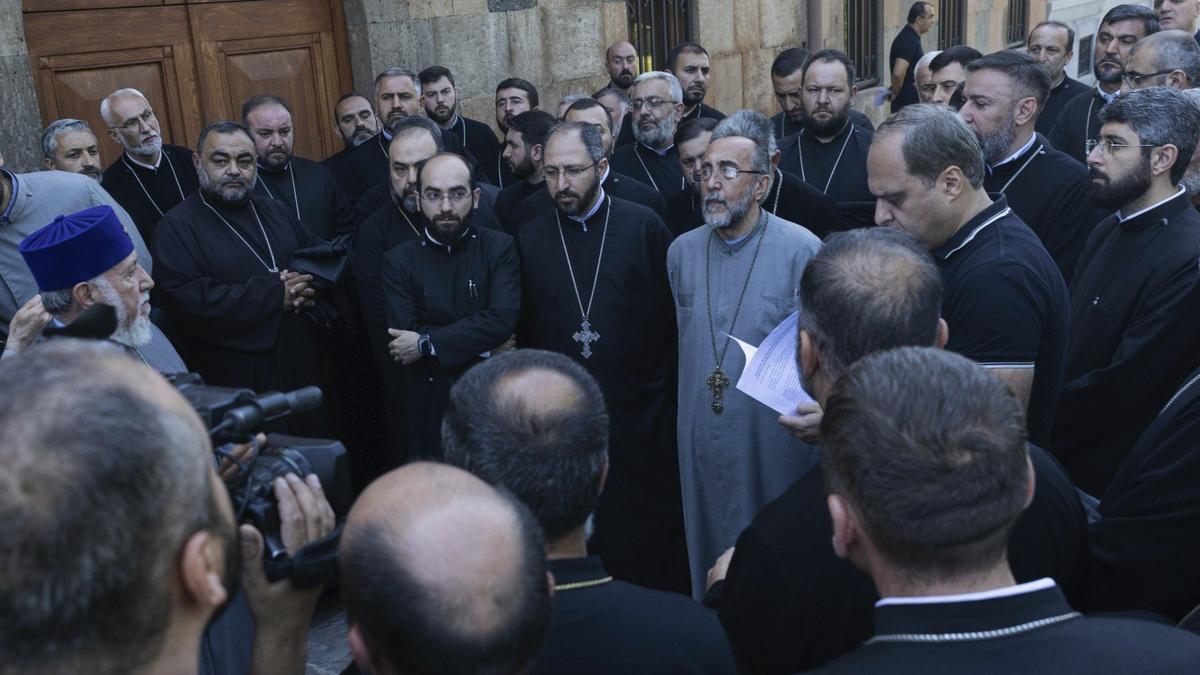
Armenian Prime Minister Nikol Pashinyan has escalated his
conflict with the Armenian Apostolic Church. In a recent speech, he accused the
Church leadership of holding an "anti-national" position, effectively
labeling Catholicos Karekin II as someone acting in the interests of the
political opposition.
Pashinyan called for mass protest gatherings in Etchmiadzin – the spiritual
capital of Armenia – a move unprecedented in the history of church-state
relations in the country.
In late June, the country’s security services attempted to
arrest Archbishop Mikael Adjapahyan directly on the grounds of the Etchmiadzin
Monastery. The raid ended in clashes with parishioners, who blocked the
monastery’s entrances. Under public pressure, the arrest turned into a court
case: the archbishop was temporarily released on bail, but the legal
proceedings continue.
The Armenian Church has traditionally played a key role in
shaping national identity and political legitimacy. The attack on the
Catholicos is not merely an ideological conflict but an attempt to weaken one
of the few independent centers of influence in the country.
By calling for protests at the walls of Etchmiadzin,
Pashinyan seeks to craft the image of a "people’s leader cleansing the
Church of corrupt elites". This is a political strategy aimed at seizing
the moral authority of the Church ahead of possible early elections. For the
first time since independence, Armenia risks facing a deep institutional rift
between the state and the Church.
It should be noted that Moscow has traditionally relied on
church structures as a loyal element of its influence in the region. The attack
on the Catholicos can be seen as a weakening of the pro-Russian lobby and a
shift towards the West. Furthermore, the intensifying conflict could lead to
mass unrest in religious centers and increased opposition protests, which are
already using the narrative of "insulting national sanctities".
Thus, this attack on the Church benefits Armenia’s leader by mobilizing his electoral base and completing his break with the "traditional elites". Moreover, weakening the conservative Church, traditionally tied to Russia, strengthens Yerevan’s pro-Western course.


 Latest news
Latest news
Latest newsMilitary Parade as a Manifesto: What Armenia Wants to Tell the World on May 28
25.May.2026
The War in Ukraine: The Russian Army is Already Running Out of Steam
25.May.2026
Railway Breakthrough: Armenia Integrates into the Akhalkalaki–Kars Route
24.May.2026
Tbilisi on the Eve of May 26: Independence Day Turns Into a Day of Political Struggle
24.May.2026
The US and Iran Continue Negotiations on a Possible Agreement and Extension of the Ceasefire
23.May.2026
The United States Suspends Participation in Ukraine Negotiations
22.May.2026
Azerbaijan and Georgia Strengthen Strategic Partnership with New Package of Agreements Signed
21.May.2026
Russia and China Strengthen Coordination on Key International Issues
20.May.2026
Beijing’s Hidden Role: Chinese Military Training for Russian Forces Revealed
19.May.2026
Pakistan Delivers Iran’s Revised Proposal to the US to End the War
18.May.2026