
 27 May 2026









Brussels revives Stalin`s influence on the Karabakh issue
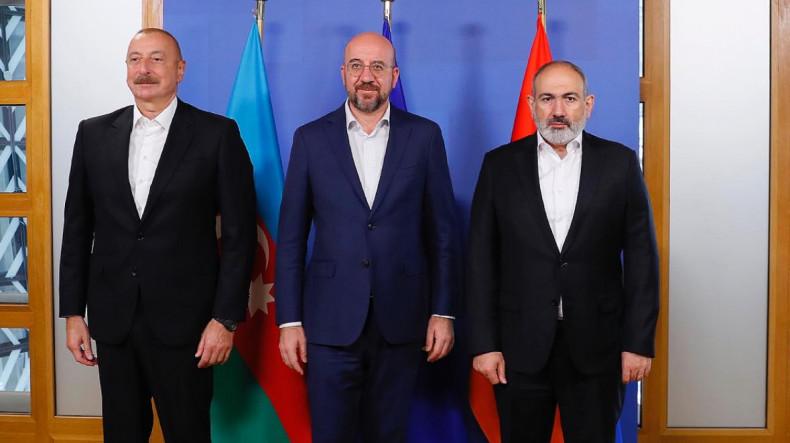
The meeting in Brussels on July 15 between Azerbaijani President Ilham Aliyev and Armenian Prime Minister Nikol Pashinyan, moderated by European Council President Charles Michel, was described as a crucial phase in negotiations. The agenda focused on six components: sovereignty and territorial integrity, border delimitation, communications, humanitarian supplies, rights and security, and detainees.
Despite Michel's commendation of the leaders' commitment to the peace process and his call for further bold steps, little progress has been made since the Prague meeting last October. In Prague, Pashinyan agreed to recognize Azerbaijan's territorial integrity, including the Armenian-populated territory of Karabakh (APTK), based on the 1991 Alma-Ata Declaration, which acknowledged existing borders. However, there has been no substantial advancement on any of the six agenda items in Brussels, and several parameters have even worsened. These include increased border restrictions between Azerbaijan and Armenia, particularly in the Lachin corridor, ongoing prisoner of war issues, lack of progress in border delimitation and a peace treaty, and heightened military incidents in Karabakh.
The facts indicate a stagnation in the negotiation process, with both parties reluctant to promote peace based on their respective interests. Azerbaijan refuses to grant separate status to the APTK, while Armenia hopes to detach the CCAMLR from Azerbaijan. It appears that the EU, as demonstrated in Michel's statement, seeks to preserve the APTK as a potential time bomb by imposing the former NKAO ((the former Nagorno-Karabakh Autonomous Region)) status created by Stalin in 1923. This is evident from the reference to the NKAO term in Michel's statement.
In contrast, the Russian Foreign Ministry's statement, released on the same day as the Brussels meeting, does not mention the NKAO. Instead, it emphasizes the importance of providing guarantees for the rights and security of Armenians in Karabakh based on the November 9, 2020 Statement. Moscow highlights Armenia's public recognition of Karabakh as part of Azerbaijan, which it asserts has altered the conditions under which the Statement was signed, as well as the status of the Russian peacekeeping contingent.
The Russian Foreign Ministry states that responsibility for the fate of the Armenian population in Karabakh should no longer be shifted to third parties. This suggests that neither Moscow, Brussels, nor any other intermediary capitals are responsible for the region's situation anymore, and the negotiation process should primarily be an internal matter between Khankendi and Baku.
In light of these developments, Russia expresses its intention to actively contribute to international efforts in restoring normalcy in Nagorno-Karabakh. The Russian government offers to host a trilateral meeting of foreign ministers in Moscow soon to discuss the implementation of high-level agreements, including negotiations on a peace treaty. It proposes convening a Russian-Azerbaijani-Armenian summit in Moscow for the signing of the aforementioned document.
This indicates that the Kremlin is unwilling to wait for the results of the two planned European meetings in autumn. However, given the global confrontation with the West, it is uncertain whether Moscow can achieve the signing of a peace treaty between Azerbaijan and Armenia. Armenia may continue to delay the process, relying on recent assurances of French solidarity with Armenians and the mention of the «NKAO» term by the European Council president. Recent European actions provide some justification for Armenia's cautious approach.


 Latest news
Latest news
Latest newsMilitary Parade as a Manifesto: What Armenia Wants to Tell the World on May 28
25.May.2026
The War in Ukraine: The Russian Army is Already Running Out of Steam
25.May.2026
Railway Breakthrough: Armenia Integrates into the Akhalkalaki–Kars Route
24.May.2026
Tbilisi on the Eve of May 26: Independence Day Turns Into a Day of Political Struggle
24.May.2026
The US and Iran Continue Negotiations on a Possible Agreement and Extension of the Ceasefire
23.May.2026
The United States Suspends Participation in Ukraine Negotiations
22.May.2026
Azerbaijan and Georgia Strengthen Strategic Partnership with New Package of Agreements Signed
21.May.2026
Russia and China Strengthen Coordination on Key International Issues
20.May.2026
Beijing’s Hidden Role: Chinese Military Training for Russian Forces Revealed
19.May.2026
Pakistan Delivers Iran’s Revised Proposal to the US to End the War
18.May.2026