
 27 May 2026









Uzbekistan, Kazakhstan ally to tap economic potential
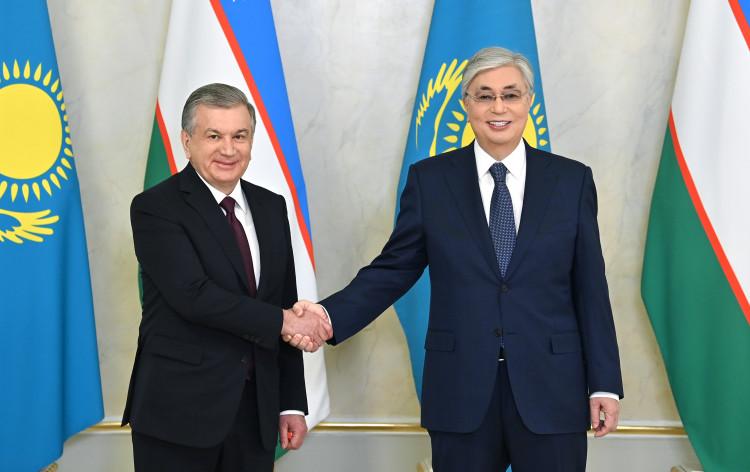
Uzbekistan and Kazakhstan have decided to take their relations to the next level upgrading them from interstate relations to forging an alliance dictated by a mutual desire for closer international cooperation based on common interests, Zaki Shaikh, UK-based analyst writes in the article for Anadolu Agency.
The summit-level meeting held between Uzbek President Shavkat Mirziyoyev and his Kazakh counterpart Kassym-Jomart Tokayev in Nur-Sultan on Monday unveiled many projects to boost bilateral economic cooperation. To upgrade relations into an alliance a supreme interstate council, an interparliamentary council, and the council of foreign ministers are being established. The principles of the alliance are reflected in the declaration signed by the two leaders.
Mirziyoyev, expected the volume of bilateral trade to reach $ 4 billion by the end of 2021. The two leaders discussed future cooperation in large projects for chemical products, pharmaceuticals, modernizing the infrastructure, creating agricultural enterprises, calibrating efforts for gearing joint automobile production with efficient marketing. For the Uzbek president, Kazakhstan's support is crucial to enable his country to pursue economic and industrial revival.
Tokayev reciprocated by announcing several initiatives including showing interest in building a plant for producing phosphorus and a range of fertilizer products in the Tashkent region at the cost of $1 billion. Kazakhstan’s largest construction company is also planning to build a new residential district in Tashkent.
Among joint industrial projects, both countries had started to manufacture cars, buses and are now planning to produce tractors in Kostanay, Kazakhstan. Household appliances are being produced in Turkestan and Shymkent. They are also upgrading textile enterprises. In Uzbekistan over 1,000 enterprises with investment from Kazakhstan are also being planned. The Kazakh Tenge Bank is operating to expand its network in the country. Both countries are also expecting the cross-border bilateral trade to grow dynamically to overcome the consequences of the slowdown caused by the pandemic, said Bakhyt Sultanov, Kazakhstan’s trade minister.
Border ties expanding
Meanwhile, in South Kazakhstan’s Turkestan city, a forum of border regions of the two countries concluded a package of agreements and contracts to expand bilateral border cooperation. Another joint venture includes the launch of textile production at the Turkistan Textile garment factory.
Border ties are expanding as new mechanisms for enhancing economic relations are being identified. Kazakhstan Deputy Prime Minister, Roman Sklyar, announced that Kazakhstan is planning to establish 24 distribution centers for wholesale trade along its borders in addition to establishing six industrial and logistic hubs to allow smooth and speedy progress for economic cooperation with adjoining countries.
Favorable conditions are being created to facilitate the movement of the people. Key projects including the construction of the Uchkuduk - Kyzylorda railway, as well as the launch of the Turkestan - Tashkent high-speed link, is also likely to roll out soon. In recent years, the air links, besides the volume of rail and road cargo transportation have been increasing. New railway routes are being worked out to remove barriers and simplify travel requirements, Tokayev told reporters.
In Nur-Sultan, Uzbek and Kazakh entrepreneurs concluded bilateral agreements in the field of mechanical engineering to the tune of over $500 million. As part of Kazakh-Uzbek industrial cooperation, the Astana-Motors company plans to build a plant for the production of Hyundai cars in Jizzakh in eastern Uzbekistan. In Kostanay, the joint production of Chevrolet cars had commenced in 2020. In November 2021, a joint venture for producing tractors has been established in Kostanay in northern Kazakhstan.
Regional cooperation
Mirziyoyiev’s efforts for rapprochement have come as an urgent response to a long-overdue need for establishing effective regional cooperation, restoring trust, and improving mutual understanding, as well as, seeking a solution to accumulated problems. Following the hardships posed by the prevalent pandemic, it had become all the more necessary.
As a full member of the Turkic Council held in November, Uzbekistan supported its transformation into the Organization of Turkic States. It has put forward a proposal to establish a Center for Research on Trade Cooperation of the Turkic States to develop proposals to increase the volume of mutual trade. Tashkent also strives for the adoption of the plan for connecting the participating countries in the transport sector, which will be of paramount importance in realizing the integration potential of the organization.


 Latest news
Latest news
Latest newsMilitary Parade as a Manifesto: What Armenia Wants to Tell the World on May 28
25.May.2026
The War in Ukraine: The Russian Army is Already Running Out of Steam
25.May.2026
Railway Breakthrough: Armenia Integrates into the Akhalkalaki–Kars Route
24.May.2026
Tbilisi on the Eve of May 26: Independence Day Turns Into a Day of Political Struggle
24.May.2026
The US and Iran Continue Negotiations on a Possible Agreement and Extension of the Ceasefire
23.May.2026
The United States Suspends Participation in Ukraine Negotiations
22.May.2026
Azerbaijan and Georgia Strengthen Strategic Partnership with New Package of Agreements Signed
21.May.2026
Russia and China Strengthen Coordination on Key International Issues
20.May.2026
Beijing’s Hidden Role: Chinese Military Training for Russian Forces Revealed
19.May.2026
Pakistan Delivers Iran’s Revised Proposal to the US to End the War
18.May.2026