
 17 Oct 2026









- The conflict between the civilian leadership of the Ministry of Defense and the military command has moved from behind closed doors into the public sphere. Disagreements that had previously remained largely hidden are now accompanied by public accusations, senior dismissals, and street protests.
- The government reshuffle suggests President Zelenskyy's determination to strengthen executive control. This marks the third major restructuring of Ukraine's government since the beginning of the full-scale war. While officially presented as an effort to improve government effectiveness, critics argue that the changes also serve to reduce the influence of independent and politically prominent figures within the administration.
- The crisis comes at a time when Ukraine's armed forces have achieved notable operational successes through the expanded use of long-range drones and strikes against Russian military and logistical infrastructure. Many observers associate these initiatives with Fedorov's leadership and reform agenda.
The Verkhovna Rada of Ukraine Forms New Government Amid Protests Over Defense Minister Dismissal
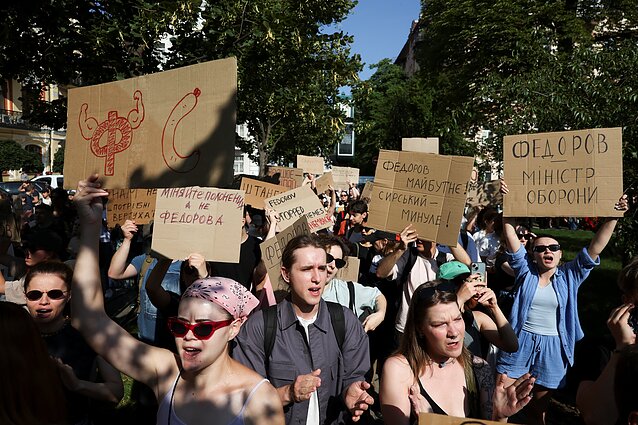
Ukraine's Verkhovna Rada has begun approving a new cabinet following a sweeping government reshuffle initiated by President Volodymyr Zelenskyy. However, the reshuffle has unfolded against the backdrop of what is widely seen as the country's most serious domestic political crisis since the start of the full-scale war, triggered by the dismissal of the popular Defense Minister Mykhailo Fedorov and protests in several Ukrainian cities.
Parliament has already approved Serhii Koretskyi, the former head of the state-owned energy company Naftogaz, as Ukraine's new Prime Minister. His appointment is part of a broader government restructuring announced by President Zelenskyy several days earlier.
The greatest public controversy has surrounded the removal of Defense Minister Mykhailo Fedorov, who had assumed the post only in January 2026. Fedorov was regarded as one of the government's most popular figures. Before becoming defense minister, he led Ukraine's digital transformation agenda and was widely recognized as one of the architects behind the integration of unmanned systems and digital technologies into the country's armed forces. As defense minister, he promoted a comprehensive modernization of the military, reforms to defense procurement, and the expanded deployment of drone capabilities.
Fedorov has stated that his reform initiatives were consistently blocked by the military leadership, particularly by Commander-in-Chief Oleksandr Syrskyi. According to the former minister, nearly every major proposal encountered resistance, leading to deep disagreements between the civilian leadership of the Ministry of Defense and the General Staff.
Following Fedorov's dismissal, demonstrations took place in several Ukrainian cities — an unusual development under martial law. Protesters called for the decision to be reversed, describing it as politically motivated.
Yevhen Khmara, the head of a Security Service of Ukraine (SBU) unit, has been appointed acting defense minister. His nomination is expected to be submitted to parliament for formal approval at a later stage. Ukrainian media had previously reported that Interior Minister Ihor Klymenko was also under consideration for the position.
President Zelenskyy has argued that the reshuffle is necessary to "renew the state system" and improve the efficiency of governance during wartime. However, some lawmakers and political analysts have questioned the timing of such sweeping personnel changes, as Ukraine continues to face intensified Russian attacks while requiring stable government management.
Fedorov's dismissal has also raised concerns among Ukraine's European partners. According to the Financial Times, Fedorov was viewed as one of the country's most effective reformers, and his removal may be interpreted as a sign of increasing political control over the security sector. Reuters has noted that European governments may find it more difficult to justify continued increases in military and financial assistance if Kyiv removes an official widely regarded as a symbol of defense modernization and greater transparency in military spending.
The developments of recent days highlight several significant trends:
The political consequences of the reshuffle will largely depend on whether the new government can maintain the pace of military modernization while preventing further confrontation between the civilian leadership and the General Staff. For now, Ukraine is facing its most significant domestic political crisis since the outbreak of the full-scale war — a development that will be closely watched by both Kyiv's Western allies and Moscow.
CCBS Expert Group


 Latest news
Latest news
Latest newsBulgaria Asks NATO to Strengthen Its Defences Amid Black Sea Threats: Sofia Fears Growing Risks to Maritime Shipping
16.Oct.2026
Black Sea Shipping Risks Threaten Bulgaria’s 5 Million Tonnes of Wheat Exports
15.Oct.2026
Georgia’s Foreign Funding and Political Ban Laws Draw Criticism from the Venice Commission
15.Oct.2026
Kazakhstan Promotes a Caspian Green Energy Corridor: Astana Seeks New Routes to the European Market
14.Oct.2026
Inflation in Romania Accelerates to 6.61%: Rising Prices Increase Pressure on Households and the Economy
13.Oct.2026
Can Europe Protect the International Criminal Court from Trump’s Sanctions?
13.Oct.2026
Georgia’s Constitutional Court Continues Case on Banning Opposition Parties: Political Pluralism at Stake
12.Oct.2026
Azerbaijan and Iran Step Up Security Contacts Amid Hijab Protests
12.Oct.2026
Personnel Shortages Complicate Ukrainian Forces’ Rotation: Ukraine Faces Long-Term Challenges on the Front Line
11.Oct.2026
Trump Eases Sanctions on Russian Fuel After Talks with Putin: Kyiv Fears Boost to Moscow’s War Revenues
10.Oct.2026
Putin Seeks to Strengthen Russia’s Influence in the Post-Soviet Space Through the CIS
10.Oct.2026
Russia and the South Caucasus: External Pressure, Political Competition and a Crisis of Trust
10.Oct.2026
Peaceful Settlement Between Armenia and Azerbaijan: Moving from Declarations to Implementation
10.Oct.2026
Moldova Ready to Accept as Many Ukrainians as Necessary if Situation Worsens This Winter
09.Oct.2026
Turkmenistan Turns Avaza into a Regional Diplomatic Hub as Caspian, Central Asian and CIS Agendas Converge
08.Oct.2026