
 17 Oct 2026









Belarus and Iran Strengthen Cooperation: Military and Economic Partnership Amid Sanctions
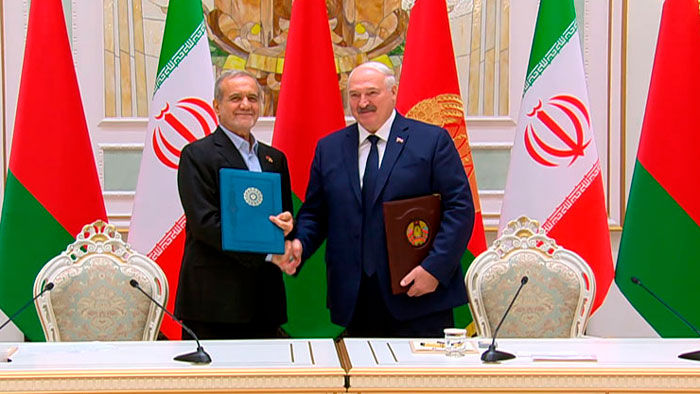
On August 20, 2025, a meeting took place in Minsk between
the presidents of Belarus and Iran – Alexander Lukashenko and Masoud
Pezeshkian. During the talks, the two sides agreed to significantly deepen
bilateral relations, including military and economic cooperation, as well as to
begin work on a strategic partnership agreement.
Lukashenko emphasized his readiness to cooperate “in all
areas – from food supplies to military-technical interaction”. Pezeshkian
promised Iran’s assistance in “neutralizing
illegal Western sanctions” based on Tehran’s 40 years of experience in
bypassing restrictions.
The strengthening of military-technical cooperation is a
clear signal of a consolidated response to Western pressure. For Minsk and
Tehran, this is an opportunity to gain access to resources and technologies
under conditions of isolation.
Both regimes are under Western pressure (Belarus – for
supporting Russia, Iran – over its nuclear and regional policies). The exchange
of experience in circumventing sanctions is a logical element of their
political and economic alliance. Russia sees this as an expansion of its sphere
of influence, where partners complement its strategic efforts.
Such an alliance could complicate containment efforts – from
military technology to the creation of financial channels outside Western
control. In response, there may be tighter sanctions policies or tactical
measures (such as restrictions on the export of technologies).
Work on a strategic agreement is not a one-year project. The
broad range of proposals (military, technological, cultural, and economic) indicates
the creation of a long-term structure capable of withstanding external
pressure.
Thus, the rapprochement between Minsk and Tehran is not just
a diplomatic move, but a structural
response to sanctions pressure, aimed at building an alternative geopolitical
architecture. Their cooperation serves as a testing ground for the formation of
a non-Russian axis of influence, with practical consequences for global
security.


 Latest news
Latest news
Latest newsBulgaria Asks NATO to Strengthen Its Defences Amid Black Sea Threats: Sofia Fears Growing Risks to Maritime Shipping
16.Oct.2026
Black Sea Shipping Risks Threaten Bulgaria’s 5 Million Tonnes of Wheat Exports
15.Oct.2026
Georgia’s Foreign Funding and Political Ban Laws Draw Criticism from the Venice Commission
15.Oct.2026
Kazakhstan Promotes a Caspian Green Energy Corridor: Astana Seeks New Routes to the European Market
14.Oct.2026
Inflation in Romania Accelerates to 6.61%: Rising Prices Increase Pressure on Households and the Economy
13.Oct.2026
Can Europe Protect the International Criminal Court from Trump’s Sanctions?
13.Oct.2026
Georgia’s Constitutional Court Continues Case on Banning Opposition Parties: Political Pluralism at Stake
12.Oct.2026
Azerbaijan and Iran Step Up Security Contacts Amid Hijab Protests
12.Oct.2026
Personnel Shortages Complicate Ukrainian Forces’ Rotation: Ukraine Faces Long-Term Challenges on the Front Line
11.Oct.2026
Trump Eases Sanctions on Russian Fuel After Talks with Putin: Kyiv Fears Boost to Moscow’s War Revenues
10.Oct.2026
Putin Seeks to Strengthen Russia’s Influence in the Post-Soviet Space Through the CIS
10.Oct.2026
Russia and the South Caucasus: External Pressure, Political Competition and a Crisis of Trust
10.Oct.2026
Peaceful Settlement Between Armenia and Azerbaijan: Moving from Declarations to Implementation
10.Oct.2026
Moldova Ready to Accept as Many Ukrainians as Necessary if Situation Worsens This Winter
09.Oct.2026
Turkmenistan Turns Avaza into a Regional Diplomatic Hub as Caspian, Central Asian and CIS Agendas Converge
08.Oct.2026