
 17 Oct 2026









Ilham Aliyev: Second Karabakh war to go down in history
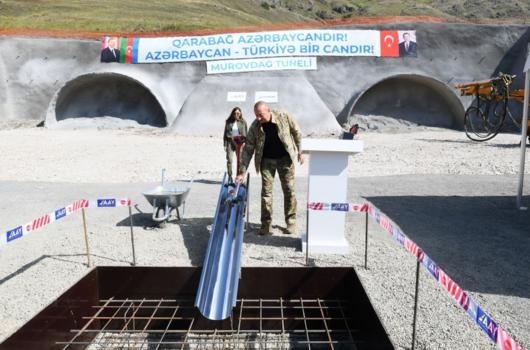
The Second Karabakh war will go down in history as our glorious Victory, Azerbaijani President Ilham Aliyev as he addressed a ceremony to raise the state flag in Kalbajar district.
He recalled that as a result of the victory, Kalbajar District was liberated from the occupiers together with Lachin and Aghdam districts. Armenia signed an act of capitulation on 10 November and undertook to return Kalbajar, Lachin and Aghdam districts to Azerbaijan.
"During the first days of the second Karabakh war, the northern part of Kalbajar was liberated by the Azerbaijani Armed Forces. There were fierce battles in the territory of Mount Murov and surrounding areas. We had martyrs. However, we took over strategic heights, and these heights allowed us the opportunity to control the transport and communication infrastructure Armenians were using. So by taking over the strategic heights in the northern part of Kalbajar, we were able to substantially limit the movement of the Armenian armed forces in this direction. As a matter of fact, they were unable to use the Basarkechar-Kalbajar road. This was a part of the military operation, the counter-offensive operation," Ilham Aliyev explained.
"We conducted the counter-offensive operation in several directions, and each direction was important. Because we were already liberating the occupied territories by breaking the line of defense in some directions, taking over strategic areas in some directions and almost paralyzing the actions of the Armenian army. In some areas, we simply conducted military maneuvering to prevent the redeployment of Armenian armed forces. Thus, a part of Kalbajar, a small part of it, was liberated on the battlefield. However, most of the district was liberated after Armenia had signed the act of capitulation," the head of state said.


 Latest news
Latest news
Latest newsBulgaria Asks NATO to Strengthen Its Defences Amid Black Sea Threats: Sofia Fears Growing Risks to Maritime Shipping
16.Oct.2026
Black Sea Shipping Risks Threaten Bulgaria’s 5 Million Tonnes of Wheat Exports
15.Oct.2026
Georgia’s Foreign Funding and Political Ban Laws Draw Criticism from the Venice Commission
15.Oct.2026
Kazakhstan Promotes a Caspian Green Energy Corridor: Astana Seeks New Routes to the European Market
14.Oct.2026
Inflation in Romania Accelerates to 6.61%: Rising Prices Increase Pressure on Households and the Economy
13.Oct.2026
Can Europe Protect the International Criminal Court from Trump’s Sanctions?
13.Oct.2026
Georgia’s Constitutional Court Continues Case on Banning Opposition Parties: Political Pluralism at Stake
12.Oct.2026
Azerbaijan and Iran Step Up Security Contacts Amid Hijab Protests
12.Oct.2026
Personnel Shortages Complicate Ukrainian Forces’ Rotation: Ukraine Faces Long-Term Challenges on the Front Line
11.Oct.2026
Trump Eases Sanctions on Russian Fuel After Talks with Putin: Kyiv Fears Boost to Moscow’s War Revenues
10.Oct.2026
Putin Seeks to Strengthen Russia’s Influence in the Post-Soviet Space Through the CIS
10.Oct.2026
Russia and the South Caucasus: External Pressure, Political Competition and a Crisis of Trust
10.Oct.2026
Peaceful Settlement Between Armenia and Azerbaijan: Moving from Declarations to Implementation
10.Oct.2026
Moldova Ready to Accept as Many Ukrainians as Necessary if Situation Worsens This Winter
09.Oct.2026
Turkmenistan Turns Avaza into a Regional Diplomatic Hub as Caspian, Central Asian and CIS Agendas Converge
08.Oct.2026